Retirement
Monthly Income From ₹50 Lakh or ₹1 Crore in Retirement
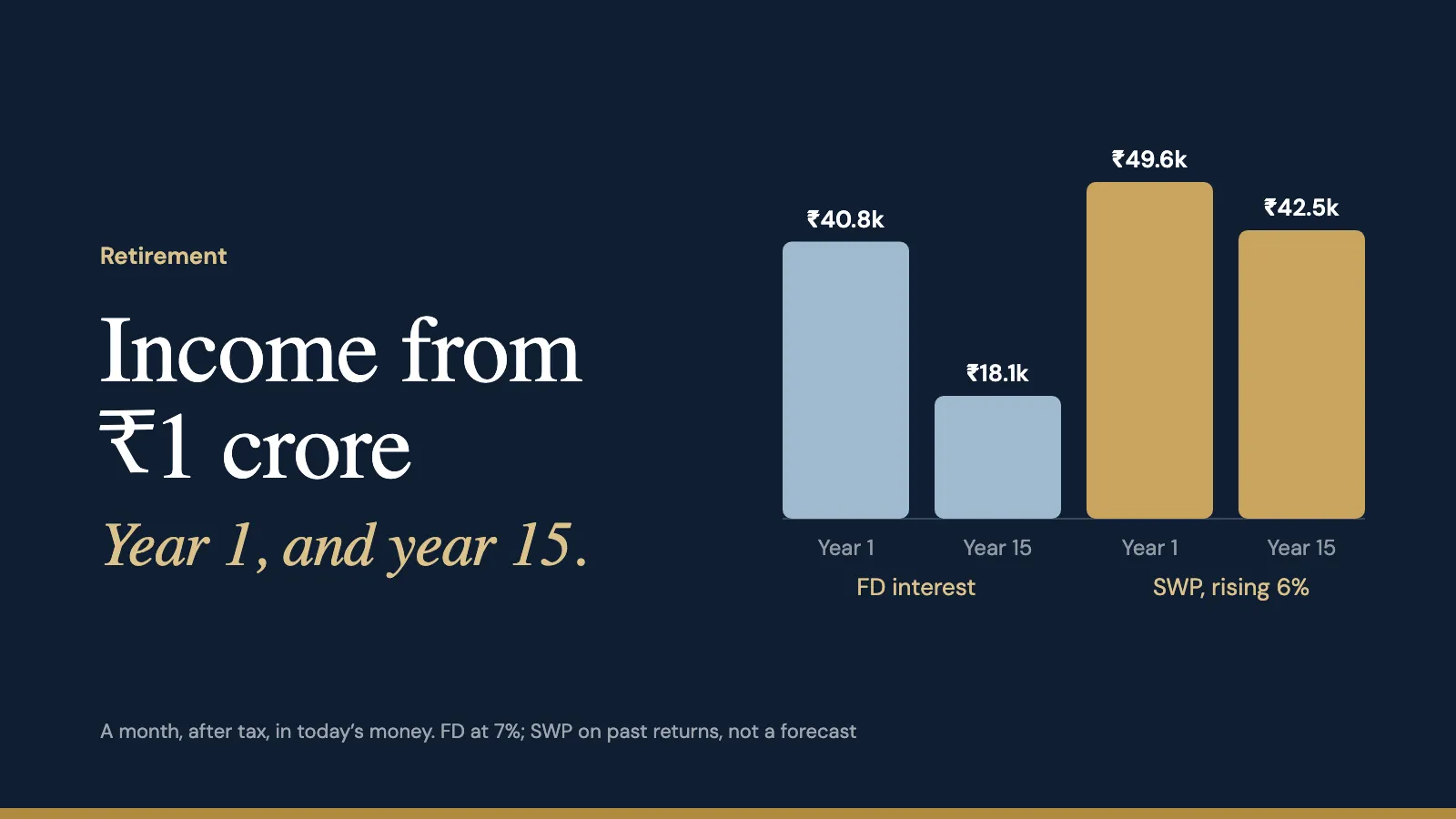
₹1 crore in an FD pays about ₹40,800 a month after tax, and by year 15 that buys what ₹18,100 does today. Here's what ₹50 lakh or ₹1 crore can pay from an FD, SCSS and an SWP, after tax and after inflation, and how safely.
· 10 min read
You’ve saved ₹50 lakh or ₹1 crore, or you will have by the time you retire. Now that money has a new job: to pay you every month, for twenty or thirty years, while prices keep rising.
If you’re working out how to get monthly income from ₹1 crore, or from ₹50 lakh, there are three usual answers: a fixed deposit, the Senior Citizens’ Savings Scheme (SCSS) and a systematic withdrawal plan (SWP). Here they are side by side, after tax and after inflation.
The short answer
- An FD at 7% pays about ₹40,800 a month from ₹1 crore, or ₹20,400 from ₹50 lakh, after 30% tax. It never falls, and never rises. By year 15, the ₹1 crore income buys what ₹18,100 does today.
- SCSS takes at most ₹30 lakh per person, or ₹60 lakh for a couple who each open one. Its income is fixed for each term.
- An SWP from a 50:50 mix of funds paid ₹50,000 a month from ₹1 crore (₹25,000 from ₹50 lakh), rising 6% a year, for 30 years without running out, on our model portfolio’s past returns. Only the gain in each withdrawal is taxed.
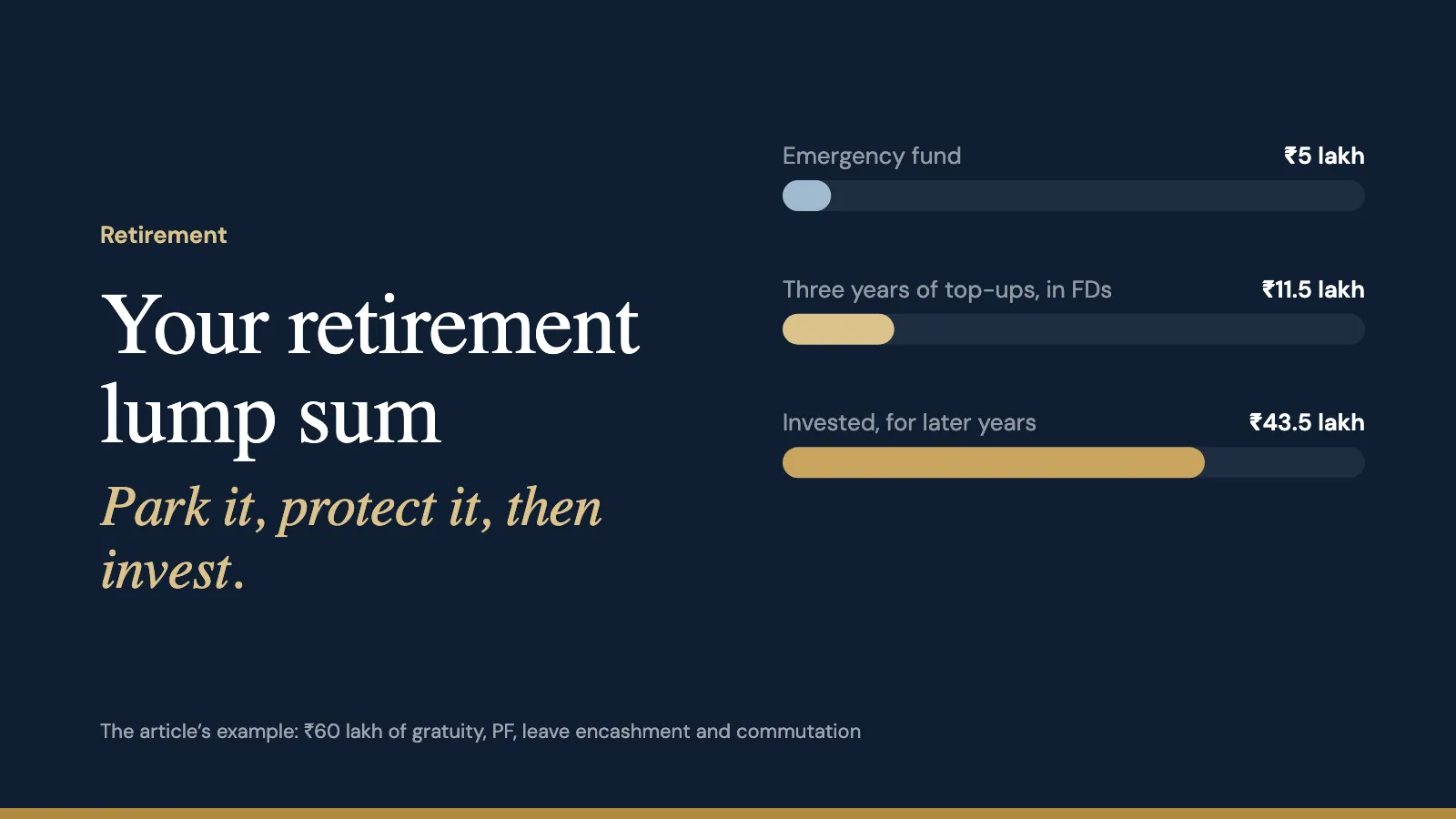
- For many retirees the answer is all three, each with its own job: the next three years of income in an FD or SCSS, the rest invested.
How much interest does an FD pay on ₹50 lakh or ₹1 crore per month?
FD interest is taxed every year at your slab rate, whether you spend it or not. Here’s the monthly interest at three assumed rates:
| Assumed FD rate | ₹50 lakh, before tax | ₹50 lakh, after 30% tax | ₹1 crore, before tax | ₹1 crore, after 30% tax |
|---|---|---|---|---|
| 6% | ₹25,000 | ₹17,500 | ₹50,000 | ₹35,000 |
| 7% | ₹29,200 | ₹20,400 | ₹58,300 | ₹40,800 |
| 8% | ₹33,300 | ₹23,300 | ₹66,700 | ₹46,700 |
Simple interest paid out monthly. Rates are illustrations, not any bank’s current rate.
So the monthly income from a ₹50 lakh FD at 7% is about ₹20,400 after tax, and the interest on a ₹1 crore FD is about ₹40,800 a month after tax.
That figure stays the same in year one and year twenty, because you spend all the interest. Take more to keep up with prices, and the deposit starts to shrink.
Two practical points. DICGC insures bank deposits only up to ₹5 lakh per depositor per bank. And we’ve used the 30% slab, as our calculators do; if interest is most of your income, your rate may be lower. Tax rules change with budgets; check with your CA.
How much can SCSS add?
SCSS is a government-backed deposit for people aged 60 and over. Retirees aged 55 to 60, and some defence retirees from 50, can open it within a set window after receiving their retirement benefits. It runs for five years, can be extended in blocks of three, and pays interest every quarter.
- ₹30 lakh is the most one person can put in. A couple can each open their own: ₹60 lakh between you.
- The government sets the rate every quarter. Check the current rate; whatever it is when you open, it stays for your term.
Every 1% of rate pays ₹30,000 a year on ₹30 lakh. At an assumed 8%, used only to illustrate, ₹30 lakh pays ₹60,000 a quarter: about ₹20,000 a month before tax, ₹14,000 after 30%. The interest is fully taxable and, like an FD’s, doesn’t rise. So SCSS can steady part of your income, but for a single person it can’t carry ₹1 crore. We set its rules beside an FD’s and an SWP’s in SCSS, FD or SWP.
What can an SWP for ₹1 crore pay?
An SWP sells a few units of your mutual funds every month and pays you the proceeds. Only the gain in each withdrawal is taxed, and what you don’t withdraw stays invested. Our post on SWP vs FD explains how it works.
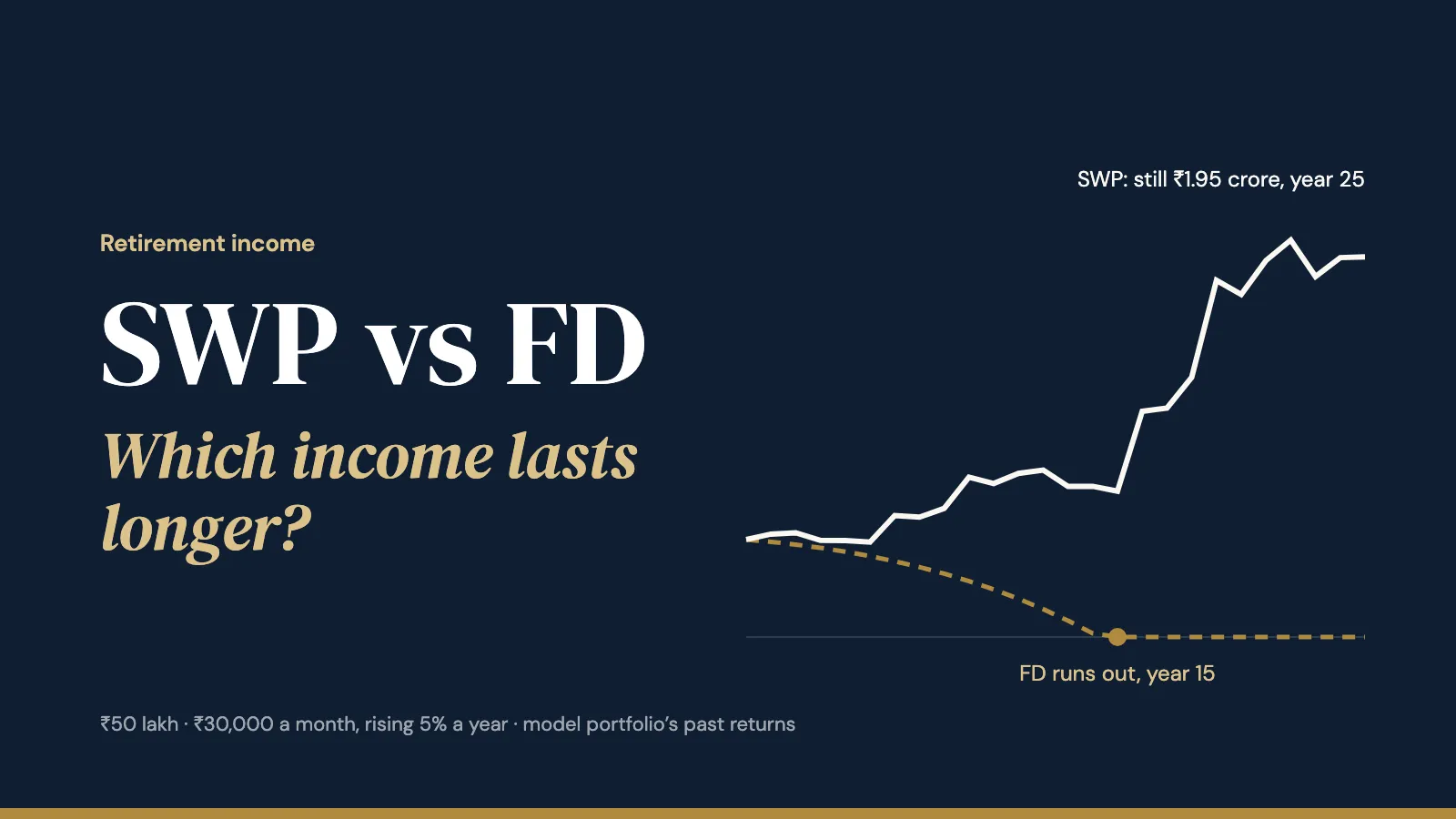
Our retirement income calculator asks a strict question: leave ₹1 crore alone for two years, then what’s the most it can pay, rising 7% a year, while what’s left still grows about 7% a year over 50 years? On our model portfolio’s past returns, ₹72,000 a month from year 3 (₹36,000 from ₹50 lakh). The same withdrawals from an FD run out in year 14.
Most people want income from the first month, so we also ran that:
| Starting income: ₹1 crore (₹50 lakh) | Rising each year | From the funds | Left at the end: ₹1 crore (₹50 lakh) | Same from an FD |
|---|---|---|---|---|
| ₹50,000 (₹25,000) | 5%, 30 years | Lasts | ₹20.1 crore (₹10.1 crore) | Runs out in year 18 |
| ₹50,000 (₹25,000) | 6%, 30 years | Lasts | ₹16.1 crore (₹8.05 crore) | Runs out in year 16 |
| ₹50,000 (₹25,000) | 7%, 30 years | Lasts | ₹11.5 crore (₹5.73 crore) | Runs out in year 15 |
| ₹60,000 (₹30,000) | 5%, 30 years | Lasts | ₹11 crore (₹5.48 crore) | Runs out in year 15 |
| ₹60,000 (₹30,000) | 7%, 25 years | Lasts | ₹1.01 crore (₹50.5 lakh) | Runs out in year 13 |
| ₹60,000 (₹30,000) | 7%, 30 years | Runs out in year 30 | ₹0 | Runs out in year 13 |
On the actual past monthly returns of our model portfolio: four equity funds and two debt funds held 50:50, over a 10-year window repeated across the timeline. Equity gains taxed at 20% in the first year and 12.5% after; debt fund gains and FD interest at 30%; FD at 7%. Past performance may or may not be sustained in future.
Two lessons. How much you draw matters most: ₹60,000 rising 7% instead of ₹50,000 rising 5% turns plenty left into nothing. And the crores at the end are not a forecast. They come from replaying one ten-year stretch, a good one for Indian shares, three times over; a weaker decade would leave far less. Read the table as “it lasted”, not “you’ll be rich”.
Year 1 vs year 15: what is your income really worth?
This is where the options split apart. Here’s what each pays per month after tax, in its first year and in year 15, with year 15 shown in today’s money at 6% inflation:
| Per month, after tax | Year 1 | Year 15, in today’s money |
|---|---|---|
| ₹1 crore FD, interest only | ₹40,800 | ₹18,100 |
| ₹1 crore SWP, ₹50,000 rising 6% | ₹49,600 | ₹42,500 |
| ₹50 lakh FD, interest only | ₹20,400 | ₹9,000 |
| ₹50 lakh SWP, ₹25,000 rising 6% | ₹24,800 | ₹21,200 |
| ₹30 lakh SCSS, interest only | ₹14,000 | ₹6,200 |
FD at 7%; SCSS at an assumed 8%, renewed at the same rate; interest taxed at 30%. SWP on our model portfolio’s past returns, taxed as above. Past performance may or may not be sustained in future.
By year 15, the FD income has lost more than half its buying power. It doesn’t look like a loss, because the number never changes.
Tax is the other half of the story. In year 1, the ₹1 crore FD’s ₹7 lakh of interest is taxed ₹2.1 lakh. The SWP’s ₹6 lakh of withdrawals carries about ₹5,000, because most of each withdrawal is your own money coming back. By year 15 more of each withdrawal is gain, and tax takes about 15% of it, which is why the SWP’s year-15 figure is below ₹50,000. After 15 years, the FD still holds ₹1 crore, about ₹41.7 lakh in today’s money. On these returns the SWP holds ₹1.9 crore, about ₹79 lakh in today’s money.
What if markets fall in your first few years?
That’s the main risk of an SWP, and it’s called sequence of returns. A fall early on, while you’re withdrawing, means selling more units at low prices, and those units aren’t there for the recovery.
To test it, we replayed the same ten years of returns starting from each of the 120 months in the window, so the falls arrive at different points:
- ₹50,000 rising 6% a year from ₹1 crore ran out in none of the 120 within 30 years.
- ₹60,000 rising 7% a year ran out within 30 years in 23 of them, the earliest in year 21.
Same money, same returns, different order. The defence is to draw an amount with room to spare, and to never be forced to sell in a fall.
Where to invest retirement money for monthly income in India?
Give each part of your money one job:
- The next three years of income, in an FD or SCSS. It pays you and never touches the market.
- The rest, in a mix of funds: equity for growth, and debt or conservative hybrid funds, which are mostly bonds with a little in shares, for steadiness.
- Refill once a year. In good years, move some gains to the safe part. In bad years, leave the funds alone and spend from the safe part.
With ₹1 crore and ₹50,000 a month rising 6%, three years of income is about ₹19.1 lakh, and an FD of about ₹17.7 lakh pays it, with its interest. The other ₹82.3 lakh is invested and left alone until year 4. On the same past returns it still lasts 30 years, ending with ₹15.2 crore instead of ₹16.1 crore. That gap is the price of safety. What it buys is that a bad year never forces you to sell, which a replay on a fixed schedule can’t show.
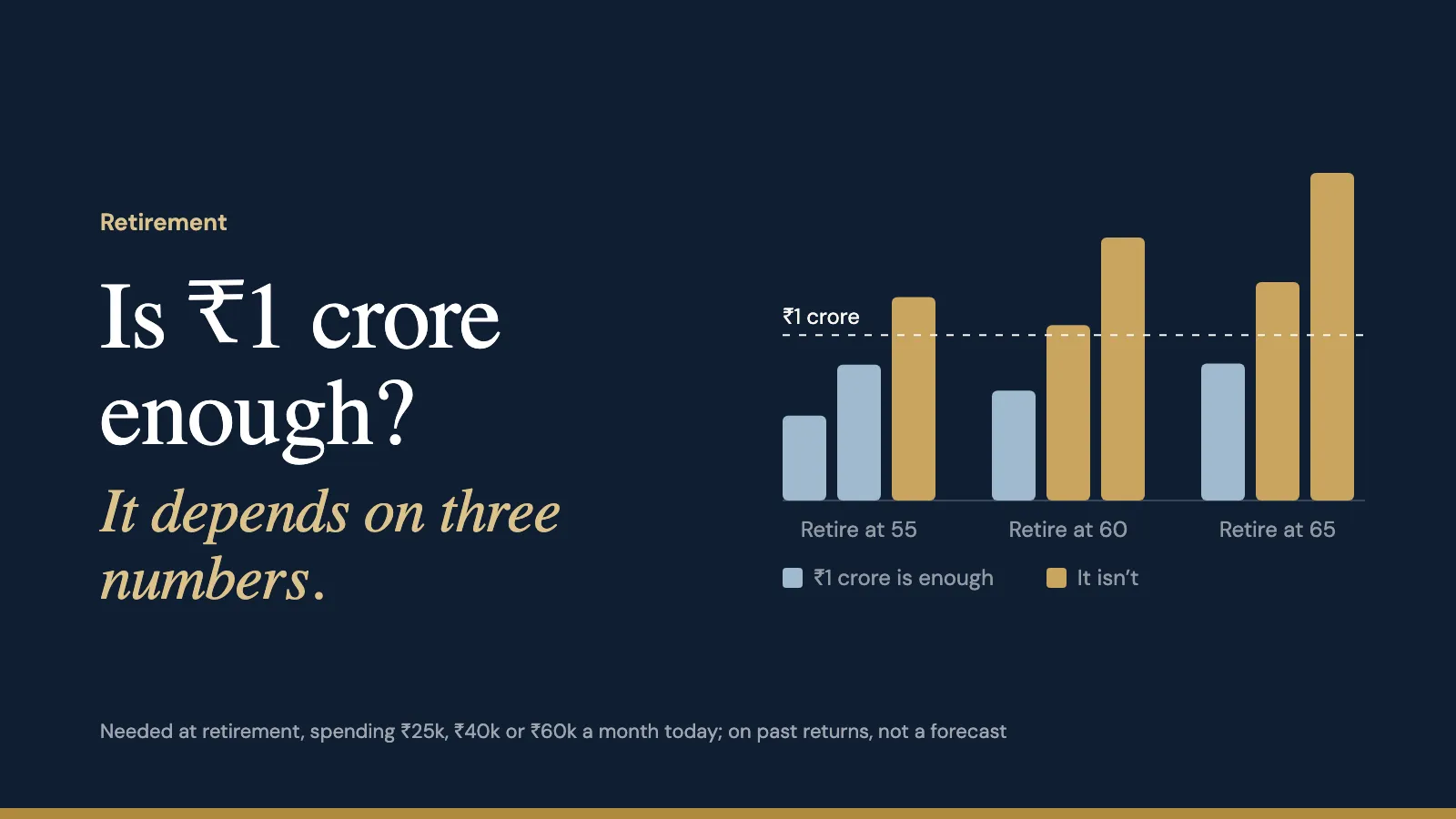
Is ₹50 lakh or ₹1 crore enough?
It depends on what you spend and how fast that rises. At 6% inflation, ₹50,000 a month today becomes about ₹89,500 in ten years. Here’s the most each amount can pay from month one, rising 6% a year for 30 years:
| Income rising 6% a year for 30 years | ₹50 lakh | ₹1 crore |
|---|---|---|
| From an FD alone | ₹12,400 | ₹24,800 |
| From the 50:50 funds, returns in order | ₹32,600 | ₹65,200 |
| Same returns, worst of 120 orders | ₹29,200 | ₹58,300 |
| Every fund’s yearly return 3 points lower | ₹24,900 | ₹49,700 |
FD at 7%, interest taxed at 30%. Fund figures on our model portfolio’s past returns; the last row cuts each fund’s yearly return by 3 percentage points as a stress test. Past performance may or may not be sustained in future.
So, roughly, if you’re retiring now: ₹50 lakh fits about ₹25,000 a month and ₹1 crore about ₹50,000, rising with prices. That holds on past returns, even in the worst order, but falls just short if every fund earns 3 points a year less. On these returns, about ₹38 lakh lasts to age 90 at ₹25,000 a month, and about ₹77 lakh at ₹50,000.
Retiring later changes the answer. If you’re 50 and spend ₹50,000 a month today, you’d need about ₹1.37 crore at 60 for that income to last to 90. The retirement calculator works it out from your own age and expenses.
What else can break the plan?
Health costs. A hospital stay is one of the quickest ways a retirement plan breaks, and cover from work usually ends with the job. Keep your own health insurance and a separate buffer you can reach in days, so a bill never lands on the money that pays your income.
Your own inflation. Medicines and help at home can rise faster than the headline rate. Set your yearly increase on what you actually spend.
Drawing more in good years. The SWP table above shows how little extra it takes to turn “lasts” into “runs out”.
What to do next
Put your own savings into the retirement income calculator to see the most they can pay, rising every year. To test a specific monthly amount, use the SWP calculator: it shows how long the money lasts, the tax and what’s left, next to an FD. Not sure where you stand? The retirement readiness check takes a couple of minutes.
When you’d like a second pair of eyes, book a review call. We’ll test your number at lower returns and show you how to keep your next three years safe.