Tax
How Is SWP Taxed? Equity, Debt and Seniors
Each SWP payment is mostly your own money coming back, and only the gain in it is taxed. Here's how that gain is worked out, the rates for equity, debt and hybrid funds, and how it compares with IDCW and FD interest.
· 8 min read
You’ve set up a systematic withdrawal plan (SWP), or you’re about to. Every month, a fixed amount reaches your bank account. Now you want to know how much of it goes in tax.
Usually less than you’d expect, especially in the early years. SWP taxation comes down to one idea, and once you have it, the rest follows.
The short answer
- Only the gain in each withdrawal is taxed. The rest is your own money coming back.
- The rate depends on the fund. Equity funds: 20% on gains from units held 12 months or less; 12.5% after that, on gains above ₹1.25 lakh a year. Debt funds bought from April 2023: your slab rate.
- Nothing is deducted at source for resident individuals, so any tax due is yours to pay.
- IDCW payouts and FD interest are taxed in full at your slab rate. An SWP’s taxable part is usually much smaller, especially early on.
How is an SWP taxed?
The tax on a systematic withdrawal plan follows from how it pays you. An SWP doesn’t pay interest. Each month it sells some of your units and sends you the money.
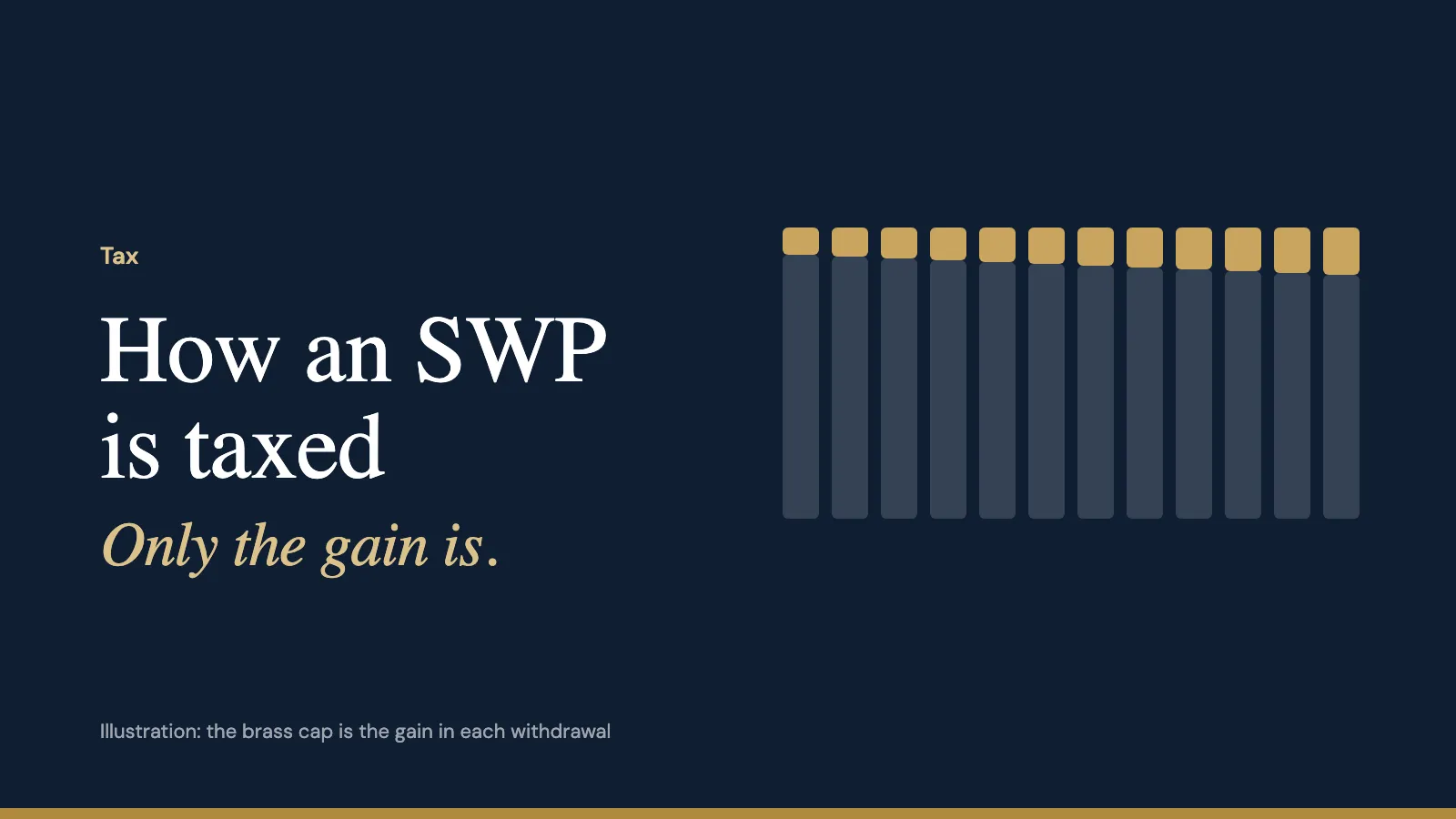
Every unit sold has two parts: what you paid for it, and what it has gained since. What you paid comes back to you untaxed, because it was your money to begin with. Only the gain is a capital gain, and only the gain is taxed.
Which units are sold? The oldest first. Fund houses sell your units in the order you bought them: first in, first out, or FIFO. That matters in two ways:
- How long they were held. Your oldest units are the likeliest to have passed 12 months, which, in an equity fund, means the lower long-term rate.
- How much they gained. Each unit’s gain is today’s NAV minus the NAV you bought that unit at. If you invested at different times, different units carry different gains.
How much of each withdrawal is taxed?
Here’s an illustration, in round numbers.
Say you invested ₹10 lakh a little over a year ago, at a NAV of ₹10, so you hold 1,00,000 units. The NAV is now ₹11.20, up 12%. Your ₹11.2 lakh includes ₹1.2 lakh of gain, so about 10.7% of anything you withdraw is gain (₹1.2 lakh ÷ ₹11.2 lakh).
You start an SWP of ₹50,000 a month. The first withdrawal looks like this:
| One ₹50,000 withdrawal | Amount |
|---|---|
| Units sold, at ₹11.20 | 4,464 |
| Your own money coming back | ₹44,643 |
| Gain: the only taxable part | ₹5,357 |
| Tax from an equity fund held over a year | Nil within the ₹1.25 lakh exemption; ₹670 at 12.5% above it |
| Tax from a debt fund, in the 30% slab | ₹1,607 |
| For comparison: ₹50,000 of FD interest, 30% slab | ₹15,000 |
An illustration, not a forecast; cess is left out. ₹50,000 a month is far more than ₹10 lakh could pay for long: the round numbers are only there to show the split.
If the NAV stayed at ₹11.20 all year, twelve withdrawals would pay you ₹6 lakh, of which only about ₹64,300 would be gain. From an equity fund held over a year, that’s within the ₹1.25 lakh exemption, so there’s no tax, as long as you have no other long-term equity gains that year.
This isn’t a trick. Most of each SWP payment is your own capital, which was never income. An FD keeps your capital and pays you interest, and all of that interest is income. And as the NAV grows over the years, the gain share of each withdrawal rises, and so does the taxable part.
What rate applies to SWP gains?
| Fund | Units held 12 months or less | Units held more than 12 months |
|---|---|---|
| Equity funds (at least 65% in Indian shares) | 20% | 12.5% on gains above ₹1.25 lakh a year |
| Debt funds bought from 1 April 2023 | Your slab rate | Your slab rate |
- The ₹1.25 lakh is per person, per year, across all your long-term gains on equity funds and listed shares. It isn’t per fund, and what you don’t use doesn’t carry forward.
- Hybrid funds are taxed by how much they hold in Indian shares. One that keeps at least 65% in shares, counting hedged positions, is taxed like an equity fund. One that is mostly bonds is taxed like a debt fund. Some in between follow rules of their own, and the scheme’s documents say which applies. Our fund category guides say which way each category usually falls.
- Debt fund units bought before April 2023 follow older rules. Your CA can work those out from your capital gains statement.
- Cess, and a surcharge on large incomes, come on top.
Is there TDS on an SWP?
Not for resident individuals. Mutual funds don’t deduct TDS on capital gains when a resident individual redeems units, and an SWP is simply a redemption every month.
That’s convenient, but it means the tax isn’t paid for you. Any tax due on the year’s gains is yours to pay: with your return, or as advance tax during the year if your tax bill is large enough. Resident seniors with no business income don’t pay advance tax.
For NRIs it’s different: fund houses do deduct TDS on redemption gains.
SWP vs IDCW (dividend) vs FD interest: how is each taxed?
IDCW, short for income distribution cum capital withdrawal, is what used to be called the dividend option. It’s partly your own money too (that’s the “capital withdrawal” in the name), yet every rupee of it is taxed.
| SWP | IDCW payout | FD interest | |
|---|---|---|---|
| What’s taxed | Only the gain in each withdrawal | The whole payout | All the interest |
| Rate | Capital gains rates, as above | Your slab rate | Your slab rate |
| When | When units are sold | When it’s paid | Every year, as it’s earned |
| TDS for residents | None | Above a small yearly threshold | Above a yearly threshold, unless you give Form 15G or 15H |
| Who sets the amount | You | The fund; it can vary or stop | The rate, fixed for the term |
We set an SWP and an FD side by side as a monthly income, over 25 years, in SWP vs FD, and SCSS alongside both in SCSS, FD or SWP.
How does the tax add up over the years?
Take the example in our SWP calculator: ₹50 lakh paying ₹30,000 a month, raised 5% every year. The same withdrawals come from an FD earning 7%.
| Withdrawn | Tax on the SWP | Tax on the FD | |
|---|---|---|---|
| Year 1 | ₹3.6 lakh | ₹3,000 | ₹1.04 lakh |
| First 5 years | ₹19.9 lakh | ₹77,300 | ₹4.87 lakh |
| First 10 years | ₹45.3 lakh | ₹3.41 lakh | ₹8.43 lakh |
The SWP is on the actual past monthly returns of our model portfolio (four equity funds and two debt funds, 50:50), with equity gains taxed at 20% in the first 12 months and 12.5% after, and debt fund gains at 30%; the ₹1.25 lakh exemption, cess and surcharge are left out. The FD earns 7%, with its interest taxed at 30%. Past performance may or may not be sustained in future.
The SWP’s tax doesn’t stay small. It grows as gains build up, and from year 15 it’s over ₹1 lakh a year. Over 25 years it comes to ₹20.1 lakh, on ₹1.72 crore withdrawn. The FD, paying the same rising income, runs out in year 15.
How is SWP taxed for senior citizens?
The rates are the same at any age. What changes is how they sit with the rest of your income:
- No TDS, and usually no advance tax. Nothing is deducted from an SWP, so there’s no Form 15H to give for it; that form is for FD interest. If you’re a resident aged 60 or over with no business income, you don’t pay advance tax either. Any tax due is paid before you file.
- The basic exemption limit. If you’re a resident and your other income is below the basic exemption limit, the unused part can generally be set against your equity fund gains before tax is worked out.
- The rebate on lower incomes. The rebate that can bring tax to nil on a modest income (long known as the section 87A rebate) works on income taxed at slab rates. Gains taxed at special rates, like the 20% and 12.5% on equity funds, are treated differently, so a small total income doesn’t by itself mean no tax on them. Debt fund gains, by contrast, are taxed at slab rates along with your pension and interest. Your CA can check how the rebate applies to your mix.
- The deduction for deposit interest. Under the old regime, seniors can deduct up to ₹50,000 a year of interest from bank and post office deposits (the deduction long known as section 80TTB). It doesn’t cover fund gains, so it’s one point in an FD’s favour.
How to keep the tax on your SWP low
- Start from units held over a year. In an equity fund, let the money sit for 12 months before the SWP begins, and draw the first year’s income from elsewhere. Your gains are then long-term, and you avoid the exit load many equity funds charge on units sold within a year.
- Use the ₹1.25 lakh every year. It’s per person, and once the year ends, what’s unused is gone. If your SWP gains are well under it, you can book more gains and reinvest to reset your cost; the March tax checklist explains how.
- Keep your capital gains statement. CAMS, KFintech or MFCentral will give you one statement across all your folios. Your CA needs it, and the gains go in your return even when no tax is due.
- Mind the date. A debt fund redemption on 31 March and one on 1 April fall in different tax years.
Tax rules change with budgets, so check the current position with your CA.
What to do next
Put your own numbers into the SWP calculator. It shows the tax along the way, next to the same withdrawals from an FD. To see how an SWP works alongside money kept safe for the next three years, read about our retirement income service. When you’d like a second pair of eyes, book a review call.