Retirement
SWP vs FD: Which Monthly Income Lasts Longer?
An FD pays you the same every month and never falls. An SWP can pay you a rising income for longer, and only its gains are taxed, but its value moves. Here is ₹50 lakh both ways, and why many retirees use both.
· 5 min read
You’ve retired, or you will soon. Your savings now have one job: to pay you every month, for as long as you need, without you having to worry about it.
For most families the answer has always been an FD. It’s familiar, it never falls, and the interest arrives on time. The real question is whether it can do that job for twenty or thirty years. Here’s how it compares with a systematic withdrawal plan (SWP), with real numbers.
The short answer
- An FD is right for money you’ll need in the next three years, and for your emergency buffer. Its value never falls.
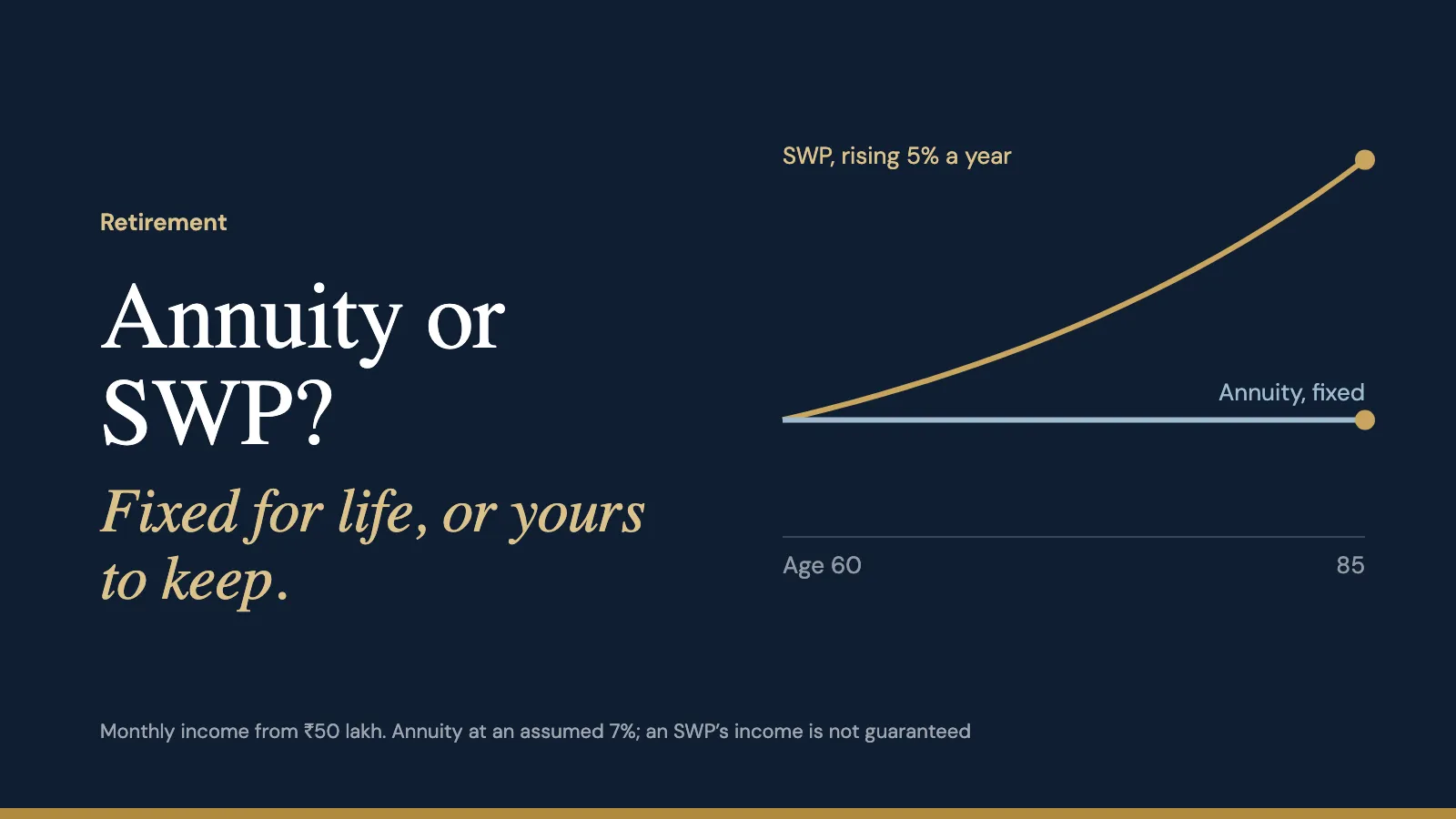
- An SWP is built for income over many years. It can pay you an income that rises, only the gain in each withdrawal is taxed, and what you don’t draw stays invested. But its value goes up and down with markets.
- For many retirees, the answer is both: the next three years in an FD or the Senior Citizens’ Savings Scheme, the rest in a mix of funds that tops it up.
How each one pays you
An FD pays you interest. Your deposit stays where it is and the interest is your income. When the FD matures, it renews at whatever the rate is that day.
An SWP pays you by selling a few units of your mutual funds every month. Each payment is partly your own money coming back and partly gain. Whatever you don’t withdraw stays invested.
| SWP | FD | |
|---|---|---|
| Your income | Can rise every year | The same every month |
| Tax | Only on the gain in each withdrawal | All the interest, at your slab rate |
| Its value | Rises and falls with markets | Doesn’t fall |
| Getting money out | Any business day; some funds charge an exit load early on | Breaking it early usually costs you |
| Best for | Income over ten years or more | Money you need in the next three years |
Why an FD quietly falls behind
Nothing goes wrong with an FD. That’s the problem. It does exactly the same thing every year while two things work against you.
Tax. FD interest is added to your income and taxed every year, whether you spend it or not. In the 30% slab, a 7% FD pays you about 4.9%.
Prices. At 6% inflation, ₹50,000 a month buys in fifteen years what about ₹20,900 buys today. An income that never rises quietly shrinks.
So to keep living the way you do, you have to take a little more each year. An FD that pays out more than it earns after tax starts eating into your deposit, and then it runs out.
The numbers: ₹50 lakh, both ways
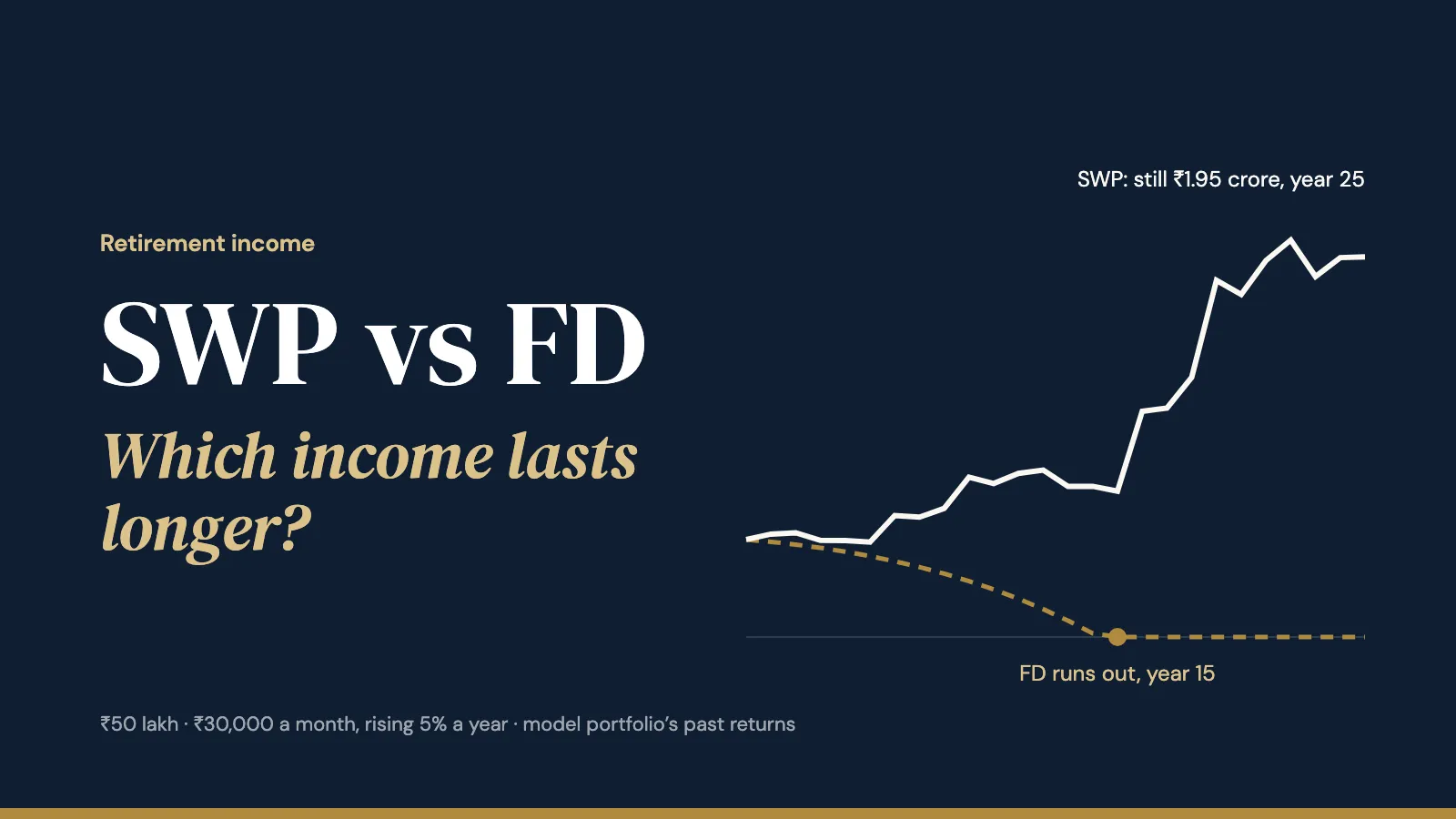
Say you have ₹50 lakh and want ₹30,000 a month, rising 5% a year to keep up with prices, for 25 years.
| Your ₹50 lakh | From an FD | From an SWP |
|---|---|---|
| Your money lasts | Until year 15 | All 25 years |
| In your hand, after tax | ₹72.5 lakh | ₹1.52 crore |
| Left after 25 years | ₹0 | ₹1.95 crore |
To pay the same rising income for all 25 years from an FD alone, you would have needed about ₹87.5 lakh, not ₹50 lakh.
The SWP figures are on the actual past monthly returns of our model portfolio: four equity funds and two debt funds held 50:50, over a 10-year window repeated across the 25 years. The FD earns 7%, with its interest taxed at 30%. Past performance may or may not be sustained in future.
The catch: an SWP’s value moves
That SWP column isn’t a smooth ride. In the same example, what was left fell in 9 of the 25 years, and for the first five years it stayed close to the ₹50 lakh you started with.
The real risk isn’t a fall on its own. It’s having to sell during a fall to pay your bills. Each withdrawal then sells more units at low prices, and those units aren’t there when prices recover.
How to use both
- Keep your next three years of income safe. In an FD, or the Senior Citizens’ Savings Scheme: a government-backed scheme for people aged 60 and over that pays interest every quarter. This part pays you every month and never touches the market.
- Invest the rest in a mix of funds. Equity for growth, debt for steadiness, held in your own name.
- Top up once a year. In good years, move some gains into the safe part. In bad years, leave the funds alone and draw from the safe part.
A bad year never forces you to sell. That’s the whole idea.
When an FD alone is the right answer
- You’ll need the money within about three years.
- It’s your emergency buffer.
- Any fall in value would cost you sleep. Then the FD is your plan, and that’s a perfectly good plan.
Run your own numbers
Put your own savings and the income you want into our SWP calculator. It shows how long your money lasts, the tax, and what’s left, next to an FD. To find the most you can draw each month while your money keeps growing, try the retirement income planner.
When you’d like a second pair of eyes, book a 20-minute review call. We’ll test your number at lower returns and show you how to keep your next three years safe. Nothing is sold in the first conversation.
Related reading
- Guardrails, Not Forecasts: deciding, in writing, what you’ll do before markets move.
- Retirement Income: how we plan a monthly income that rises with prices.
General information, not personalised advice. North Pole South Pole Financial Services is an AMFI-registered Mutual Fund Distributor (ARN-286779). The figures are illustrations on the stated assumptions and past returns, not forecasts or promises of returns. Tax rules change with budgets, so check the current rates with your CA. Mutual Fund investments are subject to market risks, read all scheme related documents carefully.