Retirement
Annuity vs SWP: Which Retirement Income Suits You?
An annuity pays you a fixed income for life, however long you live, but the money is gone. An SWP keeps the money yours and can pay a rising income, but its value moves. Here's a fair comparison, from a firm that arranges only one of them.
· 8 min read
At retirement, two very different ideas compete for your savings.
One is an annuity: you hand a lump sum to a life insurer, and it pays you a fixed income for the rest of your life. The other is a systematic withdrawal plan (SWP): you keep your money invested in mutual funds and pay yourself from it every month.
Most comparisons you’ll find are written by someone selling one of them. This one is too, so you should know which: we’re a mutual fund distributor, and we arrange SWPs. We don’t sell insurance or annuities. We’ve tried to be fair to both, and for some people an annuity is the better answer.
The short answer
- An annuity insures you against living long. It pays a fixed amount for life, however long that turns out to be. But the money is gone: you can’t get it back, and most annuities don’t rise with prices.
- An SWP keeps the money yours. Your income can rise each year, you can take out more when you need it, and what’s left goes to your family. But its value moves with markets, and if you draw too much it can run out.
- On tax, the SWP usually comes out ahead. Annuity income is taxed in full at your slab rate. With an SWP, only the gain in each withdrawal is taxed.
- Many retirees do best with both: a guaranteed income for essential bills, and an SWP on top.
What does an annuity actually do?
You pay a lump sum, called the purchase price, to a life insurer. From then on, it pays you an agreed amount every month, quarter or year. The rate is fixed on the day you buy, for life.
There are several versions, and the choice changes how much you get:
- Life annuity: pays the most each month. Payments stop when you die, and nothing is returned.
- Life annuity with return of purchase price: pays less each month, and your nominee gets back the amount you paid.
- Joint life: keeps paying your spouse after you.
- Increasing annuity: rises by a fixed percentage each year, but starts lower.
- Deferred annuity: you buy now, and the payments start later.
The older you are when you buy, the more each lakh pays, because the insurer expects to pay for fewer years. Most annuities can’t be cashed in once bought.
If you’re comparing an SWP vs a pension plan from an insurer, it’s really the same choice: most such plans end by buying an annuity. And if you’re in NPS, part of your corpus usually has to buy an annuity when you exit, so the question here is what to do with the rest of your savings.
What does an SWP keep that an annuity gives up?
An SWP sells a few units of your mutual funds every month and pays you the proceeds. Whatever you don’t withdraw stays invested. That keeps four things in your hands:
- Control. You can change the amount, pause it or stop it.
- Access. Your money is available on any business day, though some funds charge an exit load in the first year or so.
- Inheritance. Whatever is left goes to your nominees.
- A rising income. You choose how much the withdrawal grows each year.
What it gives up is certainty. Its value goes up and down. If returns are poor, or you draw too much, it can run out, and nobody pays you if you live to 100 and the money is gone.
How are annuity and SWP income taxed?
Annuity taxation in India is simple, and not in your favour.
Annuity: every rupee you receive is added to your income and taxed at your slab rate, every year. That includes the part that is, in effect, your own money coming back.
SWP: each withdrawal is partly your own capital and partly gain. Only the gain is taxed, and the rate depends on the fund:
- Equity funds: 20% on gains from units held up to 12 months; 12.5% after that, on gains above ₹1.25 lakh a year.
- Debt funds bought from 1 April 2023: gains taxed at your slab rate, however long you held them.
In the early years most of each withdrawal is capital, so the tax is small. If your total income is low enough that you pay little or no tax, the difference matters less. Our guide to how SWP is taxed goes through it step by step. Tax rules change with budgets; check with your CA.
What happens to each income when prices rise?
Most annuities pay the same rupees for life. At 5% inflation, ₹29,200 a month in year twenty buys what about ₹11,500 buys today. An increasing annuity softens this, but it starts lower.
An SWP’s income can rise every year, by as much as you choose. The catch is that a faster rise draws your money down faster.
Annuity or SWP: ₹50 lakh both ways
Say you’re 60 and have ₹50 lakh.
- The annuity: a life annuity at an assumed 7% a year, with nothing returned on death. That is not a quote: real rates vary by insurer, age, option and the day you buy. At 7%, ₹50 lakh pays ₹3.5 lakh a year, or about ₹29,200 a month.
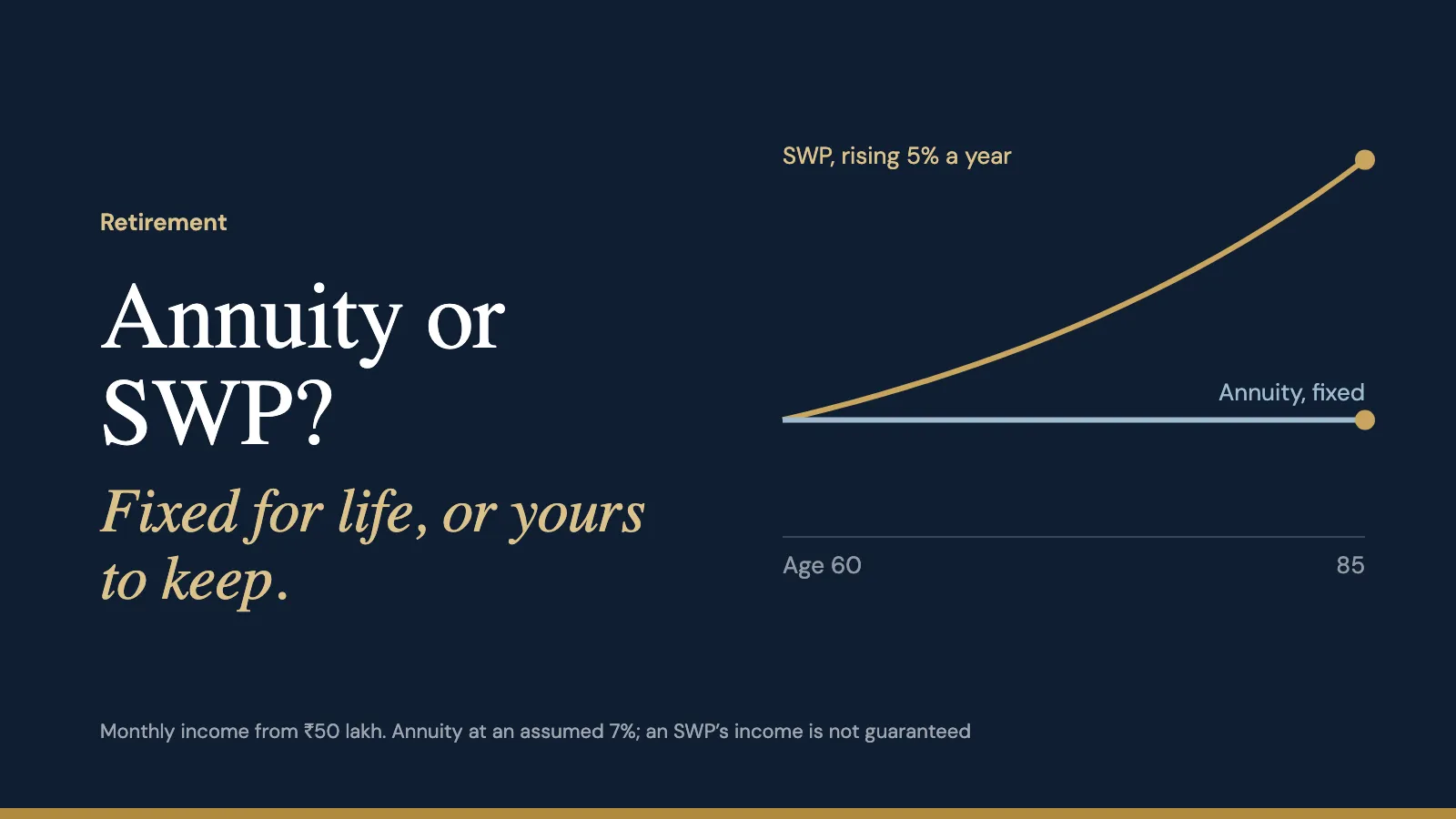
- The SWP: the same ₹29,200 a month to start, rising 5% a year.
| ₹50 lakh at 60 | Annuity (assumed 7%) | SWP |
|---|---|---|
| Monthly income, year 1 | ₹29,200 | ₹29,200 |
| In hand after tax, year 1 | ₹20,400 | ₹28,900 |
| Monthly income, year 20 | ₹29,200 | ₹73,700 |
| Received over 25 years | ₹87.5 lakh | ₹1.67 crore |
| Tax over 25 years | ₹26.3 lakh | ₹19.8 lakh |
| Left at 85 | ₹0 | ₹2.17 crore |
| Its value along the way | Fixed | Fell in 8 of the 25 years |
| If returns are 2 points a year lower | No change | ₹36.6 lakh at 85; lasts to about 90 |
| If returns are 3 points a year lower | No change | Runs out at about 82 |
| If you live to 100 | Still paying ₹29,200 | Depends on returns |
The SWP uses the actual past monthly returns of our model portfolio (four equity funds and two debt funds, held 50:50) over a 10-year window repeated, with tax on each withdrawal’s gain at 20% or 12.5% for equity and 30% for debt, and no yearly exemption. “Lower” cuts every fund’s return by that many percentage points a year. The annuity is taxed at 30%. Past performance may or may not be sustained in future.
On past returns, the SWP pays more, rises every year, costs less in tax and leaves a lot behind. Now look at the last three rows. If markets do worse, the SWP can run out somewhere between your early eighties and 90, while the annuity keeps paying whatever happens.
That is what an annuity buys you: the certainty that it will still be paying at 95. The price is a flat income, a full tax bill, and, with this option, nothing for your family.
Can you combine an annuity and an SWP?
Yes, and for many people it’s the most comfortable answer. The idea is a floor, with an SWP on top:
- Cover your essential bills with guaranteed income. Food, electricity, medicines, rent. A pension does this; an annuity can top it up.
- Pay for everything else from an SWP, which can rise and which stays yours.
Say your essentials, beyond any pension you have, come to ₹20,000 a month. At the same assumed 7%, an annuity paying that would cost about ₹34.3 lakh (₹20,000 × 12 ÷ 7%). The rest stays invested in your name.
Two things to watch. The annuity part is flat, so the SWP carries a bigger share of your costs each year; review it every year. And keep the next three years of SWP withdrawals in an FD or SCSS, so a bad year never forces you to sell. Our guide to the three-bucket retirement plan shows how.
If you already have a government or bank pension that covers your essentials, you may already have your floor, and an annuity adds less.
Which one suits whom?
An annuity may suit you if:
- You have no pension, and your essential bills aren’t covered by any guaranteed income.
- Running out of money in your nineties is your biggest worry.
- You’d rather not watch markets or make money decisions at 80.
- Leaving money to your family isn’t a priority, or you’d accept a lower income for the return-of-purchase-price option.
An SWP may suit you if:
- A pension already covers your essentials.
- You want an income that rises with prices.
- You want access to your money for emergencies, and something left for your family.
- You can live with your balance going down in some years.
Both may suit you if you’re somewhere in between, which most people are. And buying an annuity isn’t a now-or-never decision. Because each lakh pays more the older you are, some retirees start with an SWP and buy an annuity with part of their money later.
What to do next
Try our SWP calculator with your own savings and the income you want: it shows how long the money lasts, the tax and what’s left, next to an FD. Still a few years from retiring? The retirement calculator shows how much you’ll need. For how we set up a rising retirement income, see retirement income.
If you’re weighing an annuity quote against an SWP, book a review call. We’ll run the SWP side on your numbers, at lower returns too, so you can compare the two fairly.