Retirement
The Three-Bucket Retirement Plan: SWP Without Selling Low
The same returns in a different order can halve what's left of your savings once you start withdrawing. A three-bucket plan keeps your next three years of income out of the market, so a bad year never forces you to sell. This is how we set up retirement plans.
· 7 min read
An SWP pays you by selling a few units of your mutual funds every month. Most of the time, that works well.
The danger is the year markets fall 20% and your bills still need paying. Each withdrawal then sells more units, at low prices, and those units aren’t there when prices recover. A three-bucket plan, sometimes called the 3-bucket strategy for SWP, is a way of making sure that never happens. It’s how we set up retirement plans, and it’s simpler than it sounds.
The short answer
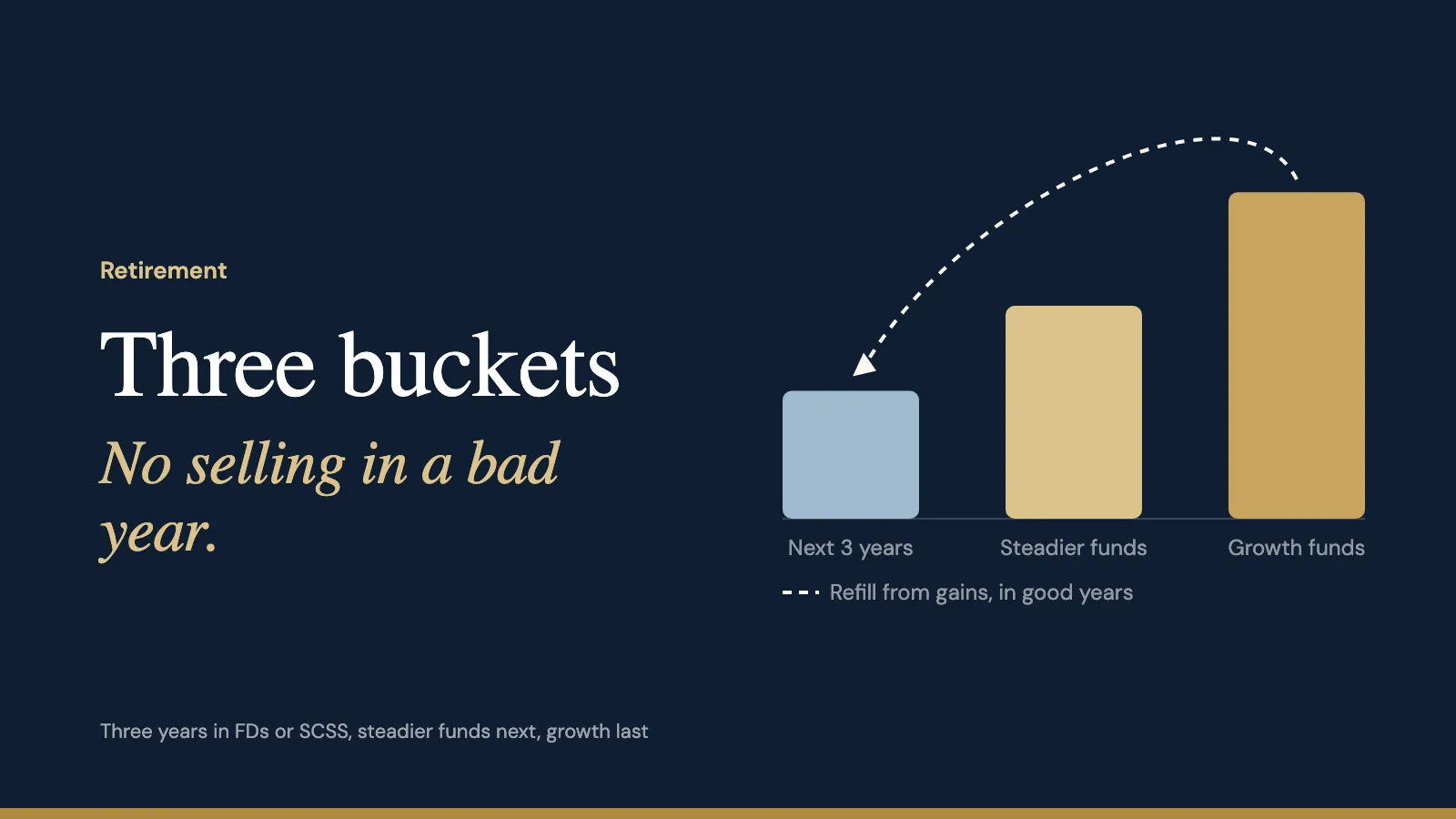
- Bucket 1: your next three years of withdrawals, in FDs or the Senior Citizens’ Savings Scheme (SCSS). It pays your income and never touches the market.
- Bucket 2: steadier funds, such as conservative hybrid or short-duration debt funds, for the middle years.
- Bucket 3: growth, in equity funds, for money you won’t need for many years.
- Refill rules, written in advance. In good years, gains top up bucket 1. In bad years, nothing is sold and bucket 1 keeps paying.
Why does the order of returns matter?
Take ₹50 lakh and ten years of returns. The same ten returns, in two different orders: good years first, or bad years first.
If you withdraw nothing, the order makes no difference. Multiply the same numbers in any order and you get the same answer.
Once you start withdrawing, the order matters a lot:
| ₹50 lakh over the same ten years | Good years first | Bad years first |
|---|---|---|
| No withdrawals | ₹90.6 lakh | ₹90.6 lakh |
| ₹3 lakh a year withdrawn | ₹60.2 lakh | ₹29.8 lakh |
Made-up returns for illustration, not a forecast: +30%, +20%, +15%, +12%, +10%, +8%, +6%, −3%, −10% and −18% (an average of 7% a year), in that order or reversed. Withdrawals at the start of each year; no tax.
Identical returns, and less than half as much left. Draw ₹4 lakh a year instead and the gap is starker still: ₹50 lakh against ₹9.5 lakh.
This is called sequence of returns risk. When a fall comes early, your withdrawals sell units at low prices, and the smaller pot that’s left has less to grow with when markets recover. The worst time for a fall is just after you’ve started drawing an income.
You can’t choose the order of returns. What you can choose is not to sell during the bad ones.
Bucket 1: what pays the next three years?
The first bucket holds three years of withdrawals in places whose value doesn’t fall:
- FDs, ideally a ladder, with one maturing each year, or monthly-interest FDs. Deposit insurance (DICGC) covers up to ₹5 lakh per depositor per bank, so larger sums are often spread across banks.
- SCSS, a government-backed scheme for people aged 60 and over, and some who retire earlier. It pays interest every quarter, at a rate set every quarter (check the current rate), with up to ₹30 lakh per person. The deposit is locked for five years, so it suits the part you won’t draw down.
The job of this bucket isn’t return. It’s that your next 36 months of income are already sitting safely, whatever markets do.
Bucket 2: what keeps the middle years steady?
The second bucket is for the years after the first three: steadier funds that can fall, but usually not as far as shares.
- Conservative hybrid funds keep 75% to 90% in bonds and 10% to 25% in shares.
- Short-duration debt funds and money market funds hold bonds and loans that mature within a few years (money market funds, within a year).
Gains on these are taxed at your slab rate when you sell.
This bucket has one important job: it’s what refills bucket 1 when bucket 3 is down. If a bad patch lasts longer than three years, this is the bucket you draw from next, and selling steadier funds that have fallen less costs you far less than selling shares at the bottom.
Bucket 3: what grows for later?
The third bucket holds money you won’t touch for many years, mostly in diversified equity funds. Balanced advantage funds, which move between shares and bonds by their own rules, sit between buckets 2 and 3, and some plans use them here for a smoother ride. They can still fall sharply in a bad year.
Why take any market risk at all in retirement? Because a retirement can last thirty years, and at 5% inflation prices more than quadruple in that time. An income that can’t grow will run short.
Our model retirement portfolio, the one our calculators use, holds the invested money half in equity funds and half in debt funds. In the ten years of past returns behind those calculators, that 50:50 mix fell about 13% in its worst single month. Falls are normal. The plan is built to sit through them. Past performance may or may not be sustained in future.
Your own split depends on how much you draw, what other income you have, and how a fall would affect your sleep.
When do you refill bucket 1?
The refill rules are the heart of the plan, and they’re written down before anything goes wrong. A typical set looks like this:
- Review once a year, on a fixed date, such as the month you retired.
- If the growth bucket rose that year and is above where it started, sell enough of the gain to top bucket 1 back up to three years.
- If it didn’t, don’t sell it. Bucket 1 keeps paying. If bucket 1 drops below two years, refill it from bucket 2, not bucket 3.
- Rebalance within a band. When bucket 3 has grown well beyond its share, move some of it to bucket 2.
- In a bad year, skip that year’s increase in income if you can. It’s the simplest way to make the money last longer.
Your rules may differ. What matters is that you write them while markets are calm, so that in a crash you’re following your own decision, not making a new one. We wrote more about this in Guardrails, Not Forecasts.
What happens in a bad year?
Say markets fall 20% in your second year of retirement.
Your income arrives as usual that month, and every month after, from bucket 1. Nothing is sold. At the yearly review, the growth bucket is down, so there’s no refill. Bucket 1 now holds about two years. If the next year is also bad, bucket 2 tops it up. Your equity funds are left alone to recover.
Here’s the same illustration as before, with three years set aside first:
| ₹3 lakh a year from ₹50 lakh | Good years first | Bad years first |
|---|---|---|
| All invested | ₹60.2 lakh | ₹29.8 lakh |
| Three years (₹9 lakh) in an FD first | ₹56.4 lakh | ₹34.1 lakh |
The same made-up returns. The FD earns an assumed 7%, with interest taxed at 30%. It is refilled at the end of a year only if the funds rose that year and are above where they started, and only from the gain above that. No tax on fund gains.
It’s worth being clear about what this shows. The bucket isn’t free: when the good years came first, it ended ₹3.8 lakh behind, because money in an FD earns less than money invested. When the bad years came first, it ended ₹4.3 lakh ahead, because the first three years’ income sold nothing at the bottom.
Notice, too, that in the bad-years-first case the FD ran dry in year four, with the funds still below where they started, so units had to be sold low after all. Three years covers many falls, not all of them. That’s what bucket 2 and the skipped increase are for.
Can an SWP go into loss?
Yes, in two ways.
A withdrawal can sell units below what you paid for them. That sale books a capital loss: for those units, you get back less than you put in. For tax, a loss isn’t wasted. Short-term losses can be set off against any capital gain, long-term losses only against long-term gains, and both can be carried forward for eight years if you file your return on time. Our guide to how SWP is taxed explains more.
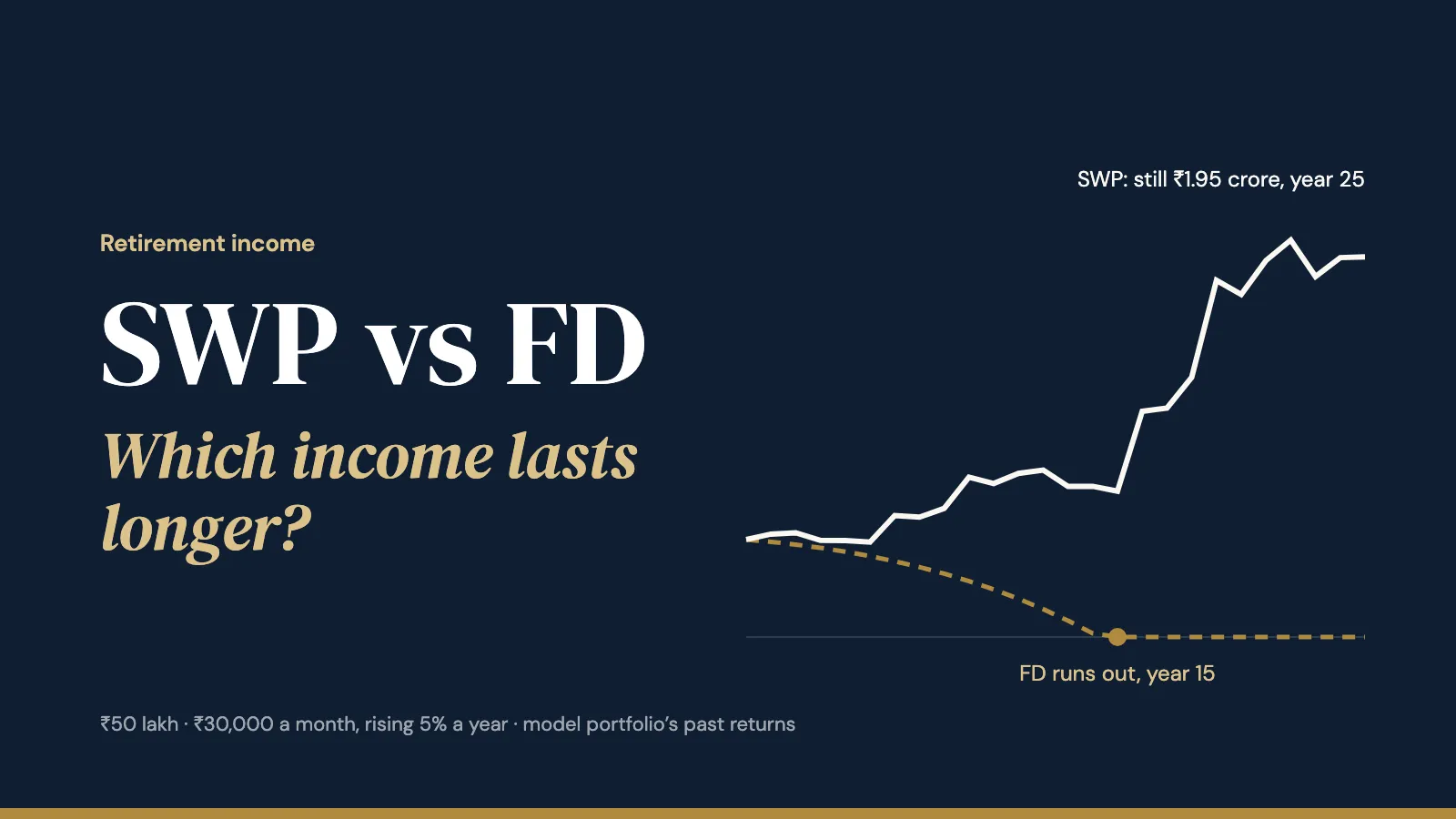
Your balance can fall below what you invested for a while, when markets fall and withdrawals continue. On our model portfolio’s past returns, ₹50 lakh paying ₹25,000 a month, rising 5% a year, ended the year lower than it started in 5 of 25 years. Past performance may or may not be sustained in future.
Neither is a disaster on its own. The real damage is forced selling: selling a lot of units at low prices to pay your bills, so fewer are left to recover. The bucket design exists to prevent exactly that. In a bad year your income comes from bucket 1, and the growth funds are left alone.
If your SWP runs straight from your funds, the same idea applies: in a bad year, move it to your steadier funds or pause it, and let bucket 1 carry you.
What to do next
Try our SWP calculator to see how long your savings last at the income you want, and what’s left, next to an FD. To see how we set up a rising income with three years kept safe, read about retirement income.
When you’d like your own buckets and refill rules written down, book a review call.