Retirement
Where to Invest Gratuity, PF and Commutation Money
Gratuity, PF, leave encashment and commuted pension can all land in the same month. Here's where to park it, what's tax-free, when the SCSS window closes, and how to turn it into a top-up for your pension, with a worked example.
· 9 min read
The month you retire, you may receive more money than you have ever held at once. Gratuity, your PF or GPF balance, leave encashment, the commuted part of your pension. For government employees, teachers, and bank and PSU staff, it can add up to tens of lakhs, all in a few weeks.
Almost at once, people start telling you what to do with it. If you’re wondering where to invest gratuity money, or where to invest PF money after retirement, the answer starts with not investing it at all, for a few weeks. This guide is for that month. It’s written with retirees in Andhra Pradesh in mind, but the approach works anywhere in India.
The short answer
- For the first 90 days, just park it somewhere safe and easy to reach: a savings account with auto-sweep, or a liquid fund. Don’t commit it yet.
- Your pension is your floor. Work out the gap between what you spend each month and what your pension pays. The lump sum’s job is to fill that gap for thirty years, rising with prices.
- Keep three years of that top-up safe, in FDs or the Senior Citizens’ Savings Scheme (SCSS). If you retire between 55 and 60, the SCSS window closes a few months after your benefits are paid.
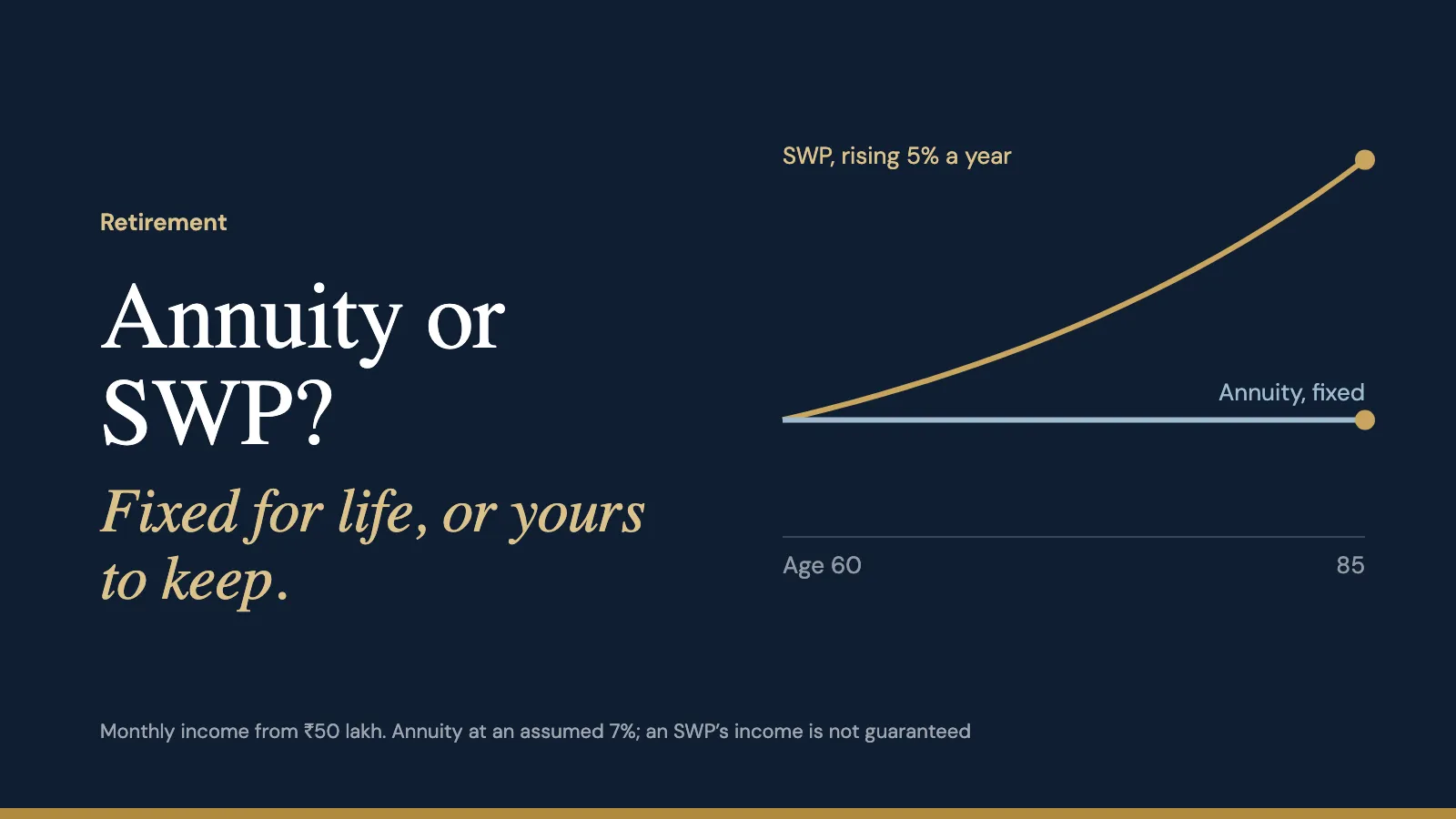
- Invest the rest in a mix of funds, and draw a rising monthly top-up from it with a systematic withdrawal plan (SWP).
What money arrives in the month you retire?
Your retirement benefits usually include some of these:
- Gratuity: a lump sum for your years of service.
- PF or GPF: your provident fund balance, with its interest.
- Leave encashment: cash for the earned leave you didn’t take.
- Commuted pension: if you chose to commute, a lump sum in exchange for a smaller monthly pension, usually for a set number of years.
- Sometimes a group insurance or savings-fund payout.
One thing doesn’t arrive as a lump sum: your pension. It keeps coming every month for life, and for most government and bank pensioners it rises with dearness relief. That’s your floor, the part of your spending that is already paid for.
Commutation of pension trades part of that floor for cash today. Once you’ve done it, the lump sum has to earn its keep, because it’s standing in for income you’ve given up.
If you’re an AP government employee or teacher, how much you can commute, the commutation factor and when the commuted part is restored are set by the state’s pension rules and shown in your pension sanction (your PPO). They change from time to time, so take them from your PPO, your drawing officer or the state’s official orders.
If you’re under the contributory pension scheme (NPS) rather than the old pension, your floor works differently: part of your NPS corpus usually has to buy an annuity when you exit.
Is gratuity, PF or commuted pension taxable?
Here is what we can say with confidence:
- If you’re a central or state government employee, gratuity, commuted pension and leave encashment received at retirement are fully exempt from income tax.
- If you worked for a PSU, a bank or a private employer, part of each is exempt, up to limits and formulas set by the tax law. They’re fiddly and they change, so check your limits with your CA before you count the money as tax-free.
- PF and GPF balances paid at retirement are generally tax-free after long service. There are exceptions, such as interest on very large yearly contributions, so check yours.
What the money earns from here on is taxed in the usual way. FD and SCSS interest is taxed at your slab rate every year. With mutual funds, only the gains are taxed, and only when you sell.
One more thing. The Income-tax Act, 2025 replaced the old Act from April 2026 and renumbered its sections, so when you speak to your CA, ask about the rule, not the old section number. Tax rules change with budgets; check with your CA.
What should you do with the money in the first 90 days?
Park it, and wait. Two simple places:
- A savings account with auto-sweep. Money above a set balance moves into FDs automatically, and comes back when you need it. Deposit insurance (DICGC) covers up to ₹5 lakh per depositor per bank, so if ₹60 lakh sits in one bank, most of it is beyond that cover. Large sums are usually spread across banks.
- A liquid fund. These lend for up to 91 days, so their value moves very little. Money usually reaches your bank the next business day, and many offer instant redemption of up to ₹50,000 a day to resident individuals. A small exit load applies if you sell within six days. Gains are taxed at your slab rate when you sell.
Then say no to anything pushed at you in the first few weeks. Retirement money attracts sellers: insurance-cum-investment policies, “guaranteed income” plans, company deposits paying unusually high rates, a relative’s business. None of it is urgent. A good option will still be there in three months.
Use the 90 days to gather your papers, write down what you spend, and work out your gap. The one decision that can’t always wait is SCSS.
When does the SCSS window close?
The Senior Citizens’ Savings Scheme is a government-backed deposit that pays interest every quarter. You can put in up to ₹30 lakh per person, for five years, extendable in blocks of three. The interest is fully taxable, and the rate is set by the government every quarter, so check the current rate before you invest.
- If you retire at 60 or later, you’re eligible on age alone. There’s no window.
- If you retire between 55 and 60, on superannuation or voluntary retirement, you can open an account only within a set period after your retirement benefits are paid: three months under the rules as amended in November 2023. The deposit can’t be more than the benefits you received. Retired defence services personnel can open one from 50.
Check the current rule at the post office or your bank, and don’t let your 90-day pause run past the deadline.
SCSS pays you its interest, but the deposit itself is locked for five years, and closing early costs you a deduction. So it suits money you won’t need back for five years. For the three years of top-ups you’ll draw down, FDs that mature one each year are simpler. Our guide to SCSS vs FD vs SWP compares the three in detail.
How much do you need each month on top of your pension?
This is the number the rest of the plan is built on.
- Write down what you spend in a month. Add yearly costs, such as insurance premiums, festivals, travel and help for your children, and divide them by twelve.
- Subtract your pension, after tax.
- What’s left is your gap. That’s what the lump sum has to pay, every month, rising with prices.
If your pension rises with dearness relief, your gap rises roughly with prices. If it doesn’t (EPS pensions, for example, don’t), your gap grows faster, so allow for that. Our retirement readiness check helps you put the numbers together.
A worked example: ₹60 lakh, a ₹50,000 pension, ₹80,000 of spending
Say you retire at 60. Your pension is ₹50,000 a month and you spend ₹80,000, so your gap is ₹30,000 a month. Gratuity, PF, leave encashment and commutation come to ₹60 lakh. We assume your pension and your spending both rise 5% a year, so the gap rises 5% a year too.
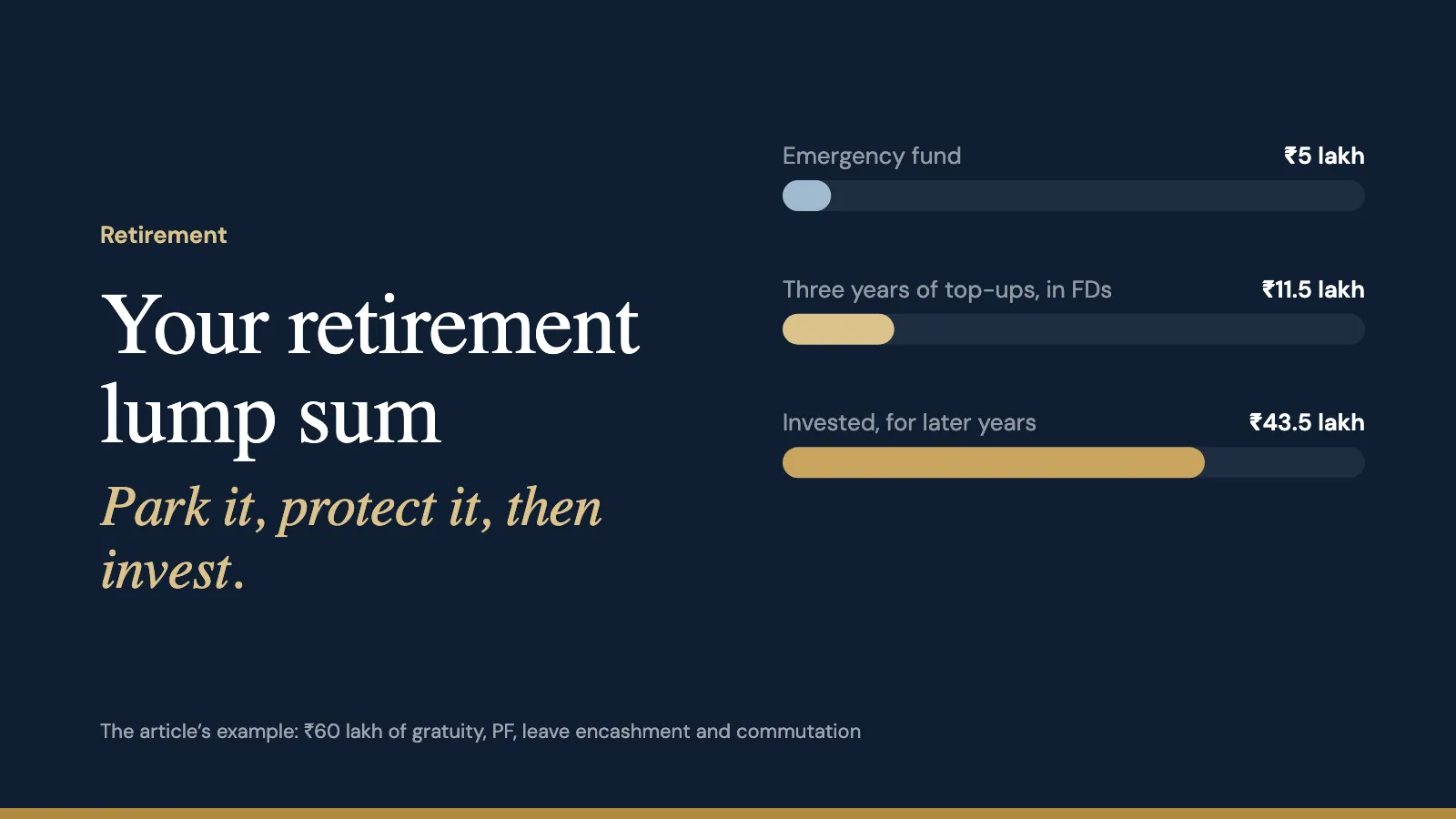
Here’s how the ₹60 lakh could be split:
| Part | Amount | Its job |
|---|---|---|
| Emergency fund: auto-sweep or liquid fund | ₹5 lakh | Surprises: a hospital bill, a repair |
| Safe part: FDs maturing one each year | ₹11.5 lakh | Your top-up for years 1 to 3: ₹3.6 lakh, ₹3.78 lakh and ₹3.97 lakh |
| Invested in a mix of funds | ₹43.5 lakh | Left alone for three years, then an SWP pays your top-up: ₹34,700 a month, rising 5% a year |
At an assumed 7% FD rate, with the interest taxed at 30%, the safe part pays all three years and has about ₹1.1 lakh left over.
So how long does it last? Markets won’t repeat the past, so here it is at three levels of returns, next to the same ₹55 lakh kept in FDs:
| Returns | Your top-up is paid | Left at 90 |
|---|---|---|
| Our model portfolio’s past returns | Until at least 100 | ₹7.63 crore |
| 2 percentage points a year lower | Until about 97 | ₹89.7 lakh |
| 3 percentage points a year lower | Until about 85 | ₹0 |
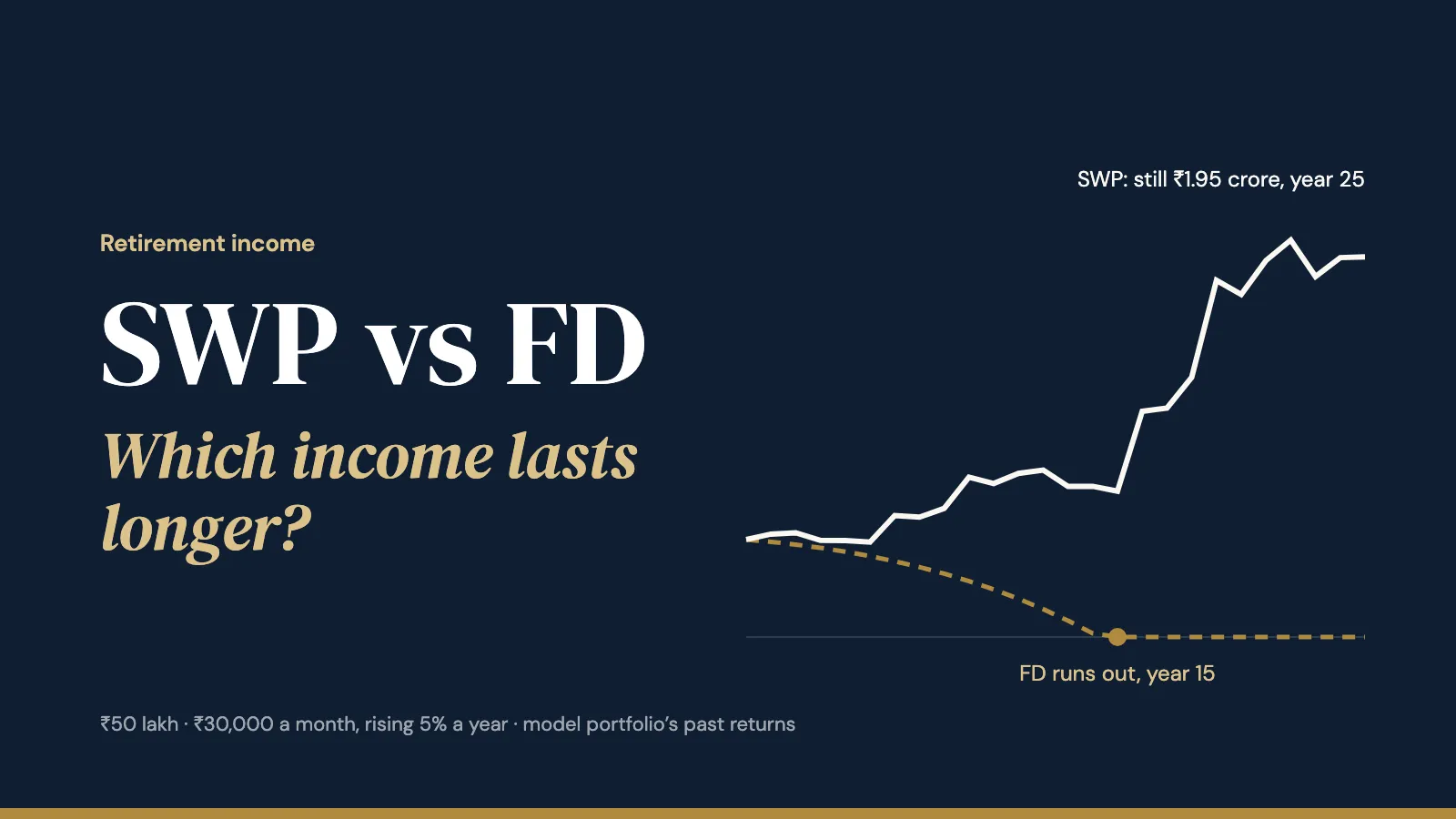
| FDs only: all ₹55 lakh at an assumed 7% | Until about 75 | ₹0 |
The fund rows use the actual past monthly returns of our model portfolio (four equity funds and two debt funds, held 50:50) over a 10-year window repeated, with tax paid out of each withdrawal; the lower rows cut every fund’s return by 2 or 3 percentage points a year. The FD row pays the same rising top-up from ₹55 lakh, with interest taxed at 30%. Past performance may or may not be sustained in future.
Three things stand out.
FDs alone run short. They pay the rising top-up for about fifteen years, then stop.
The funds’ result depends a lot on returns. Three points a year is the difference between a large surplus (₹7.63 crore is about ₹1.8 crore in today’s prices, at 5% inflation) and running out at about 85. That’s why we test every plan at lower returns, and why the yearly increase is a lever: skip it in a bad year and the money lasts longer.
Your pension keeps coming in every row. Even if the investments ran out at 85, you would still have your pension, rising with dearness relief. That’s what a floor is for.
In practice, the safe part isn’t left to run dry. In good years, some gains move across to keep three years there, and in bad years the funds are left alone. Our guide to the three-bucket retirement plan shows how those refills work.
Your first-year checklist
- Collect your papers: PPO, gratuity and commutation sanctions, PF or GPF settlement, leave encashment order.
- Park the lump sums in auto-sweep or a liquid fund, spread across banks if they’re large.
- If you’re between 55 and 60, note the SCSS deadline and decide on SCSS first.
- Write down your monthly spending, with yearly costs divided by twelve.
- Work out your gap: spending minus pension, after tax.
- Check what health cover continues after you retire, and whether you need more.
- Update nominations on every bank account, FD and fund.
- Ask your CA what’s exempt and which tax regime suits your new income.
- Keep an emergency fund aside.
- Only then: three years of top-ups into FDs or SCSS, the rest invested.
- Write down when you’ll refill the safe part, and review once a year.
What to do next
Put your own gap and lump sum into our SWP calculator to see how long it lasts, the tax, and what’s left, next to an FD. For the most you could draw each month, try the calculator on our retirement income page.
When you’re ready, book a review call. We’ll go through your benefits, test your numbers at lower returns and set up the three-year safe part with you.