Retirement
SCSS, FD or SWP: What Each Is For in Retirement
SCSS, a bank FD and a mutual fund SWP aren't rivals. Each is good at one job and poor at another. Here's how each works, how it's taxed, and how a couple with ₹1.2 crore might use all three.
· 9 min read
You’ve retired, or soon will, and the money you’ve saved now has to pay you. Three names come up in every conversation: the Senior Citizens’ Savings Scheme (SCSS), a bank FD, and a systematic withdrawal plan (SWP) from mutual funds.
Most comparisons try to pick a winner. That’s the wrong question. Each one is good at a different job, and many retirees use all three. Here’s how each works, what it’s for, and a worked example for a couple.
The short answer
- SCSS is for a steady, government-backed income in the near years. It pays every quarter, fixed for its term, up to ₹30 lakh per person.
- An FD is for money you may need at short notice and for anything above the SCSS limit. It never falls, but its income never rises.
- A mutual fund SWP is for the later years, when rising prices bite. Its income can rise and only the gain is taxed, but its value goes up and down.
- Used together, the safe part pays the next few years so the funds are never sold in a fall.
How does SCSS work?
- Who can open it: anyone aged 60 or over. Retirees aged 55 to 60 can open it within the window allowed after they receive retirement benefits (three months under the 2023 rules; check the current rules), and some defence retirees from 50.
- How much: from ₹1,000, in multiples of ₹1,000, up to ₹30 lakh per person across all your SCSS accounts. A couple can each open their own.
- How long: five years. When it ends, you can extend it in blocks of three years.
- How it pays: interest every quarter, not every month.
- The rate: set by the government every quarter. Check the current rate before you invest. The rate on the day you open stays for your whole five-year term, even if rates later fall or rise.
- Getting out early: possible, at a cost that is higher the earlier you close.
- Where: post offices and authorised banks. You can check current rates on the National Savings Institute site.
Is SCSS interest taxable?
Yes. All SCSS interest is added to your income and taxed at your slab rate every year, under both regimes. Tax may be deducted at source on it.
Under the old regime only, the deposit can count towards the ₹1.5 lakh deduction long known as section 80C. And seniors under the old regime can deduct up to ₹50,000 a year of deposit interest, a deduction long known as section 80TTB. Whether the old regime suits you is a question for your CA.
FD interest is taxed the same way: every year, at your slab rate, spent or not.
An SWP is taxed differently. Each withdrawal is partly your own money coming back and partly gain, and only the gain is taxed. Gains on equity fund units held over 12 months are taxed at 12.5% above ₹1.25 lakh a year, and at 20% if held 12 months or less. Gains on debt fund units bought from 1 April 2023 are taxed at your slab rate. How an SWP is taxed works through an example. Tax rules change with budgets; check with your CA.
SCSS vs FD vs mutual fund SWP, side by side
| SCSS | Bank FD | Mutual fund SWP | |
|---|---|---|---|
| Who | 60 and over (some retirees earlier) | Anyone | Anyone |
| Safety | Government-backed | DICGC insures up to ₹5 lakh per depositor per bank | Not guaranteed; value rises and falls |
| Limit | ₹30 lakh per person | None | None |
| Your income | Fixed for the term | Fixed for the term | You set it, and it can rise every year |
| Paid | Every quarter | Monthly or quarterly, as you choose | Monthly, or as you choose |
| Tax | All interest, at your slab rate | All interest, at your slab rate | Only the gain in each withdrawal |
| Getting money out | Five-year term; closing early costs you | Breaking early usually costs you | Any business day; some funds charge an exit load early on |
| Inflation | Income doesn’t rise | Income doesn’t rise | Income and value can grow, though not guaranteed |
| The rate | Set every quarter; fixed once you open | Set by your bank; fixed for the term | No rate; depends on markets |
SCSS vs FD: what’s the real difference?
Both pay a fixed income, both are taxed the same way, and neither falls in value. The differences are in the details.
SCSS is backed by the government; an FD is insured only up to ₹5 lakh per bank. SCSS locks you in for five years, while an FD can be as short as you like. SCSS pays quarterly; many banks offer FDs that pay monthly. And SCSS stops at ₹30 lakh per person, so anything beyond that has to go somewhere else.
So the two work as a pair. SCSS takes the first ₹30 lakh of your safe money; FDs hold the rest of it, and the emergency money you might need next month.
SCSS vs mutual fund: what’s the real difference?
An SWP sells a few units of your funds every month and pays you the proceeds. Say a fund’s units are worth ₹50 and you withdraw ₹30,000: about 600 units are sold. If you bought them at ₹40, only ₹10 of each ₹50 is gain, ₹6,000 in all, and that’s the part that’s taxed.
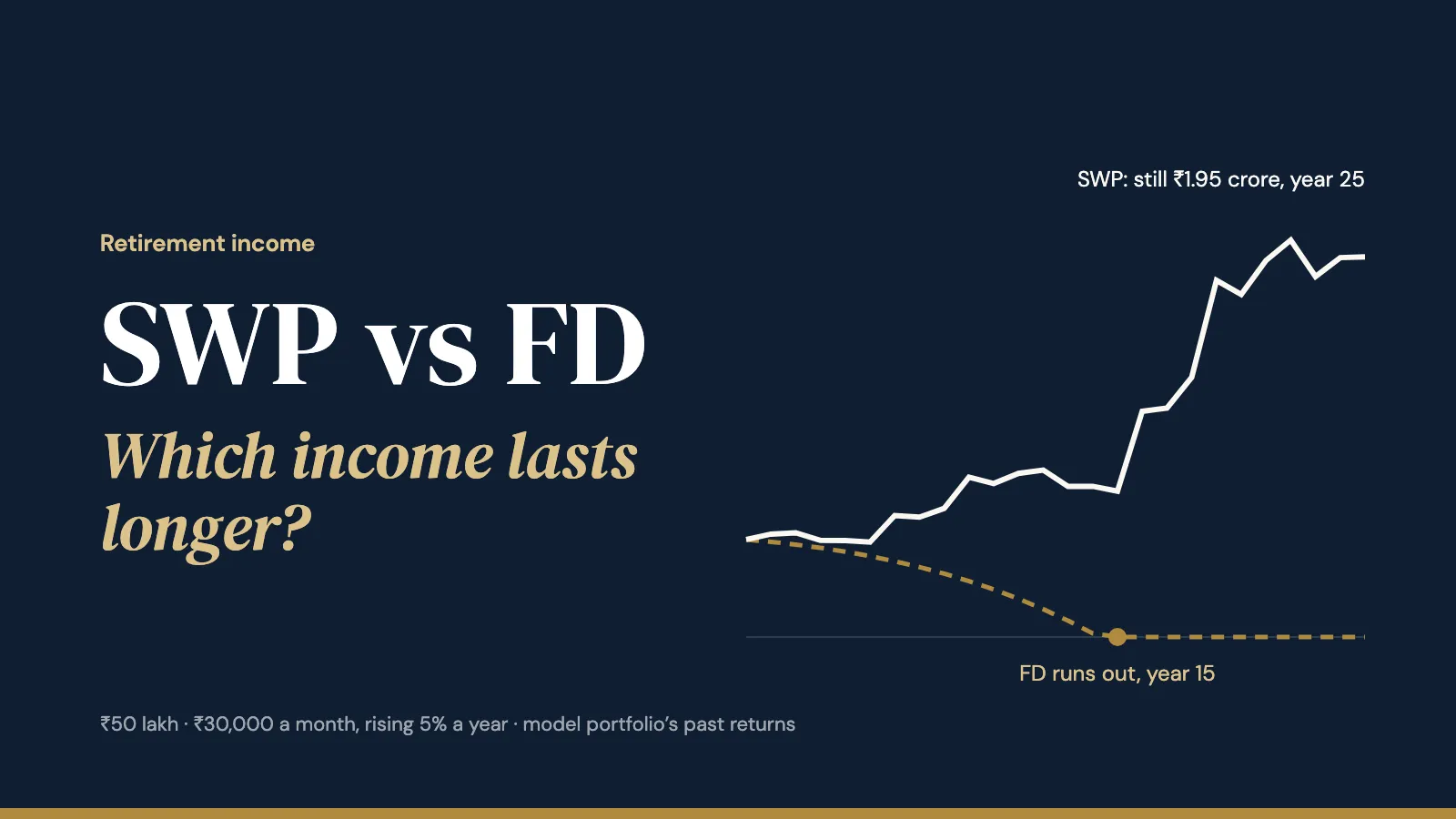
What you don’t withdraw stays invested. That’s how an SWP can pay an income that rises every year. It’s also why its value moves: in a bad year for markets, what’s left can fall, and selling during a fall uses up more units. Our post on SWP vs FD shows how that played out with ₹50 lakh.
SCSS gives you certainty for five years. An SWP gives you a chance of keeping up with prices for thirty. You need both kinds of money.
SCSS vs Post Office MIS, RBI bonds and PMVVY
Three other names come up when people compare SCSS with alternatives:
- Post Office Monthly Income Scheme (MIS): also a five-year deposit, but open to any resident adult, and it pays interest every month rather than every quarter. Its limits are lower than SCSS’s (₹9 lakh in a single account, ₹15 lakh joint; check the current limits), and the interest is taxable.
- RBI Floating Rate Savings Bonds: seven-year bonds with interest paid every six months. Unlike SCSS, the rate isn’t locked: it’s reset every six months, up or down. There’s no upper limit and the interest is taxable. You generally can’t cash them early, except older investors after a lock-in that depends on age.
- PMVVY (Pradhan Mantri Vaya Vandana Yojana): a pension scheme for seniors, run by LIC, that closed to new investment on 31 March 2023.
Each is a fixed-income option with its own rules. None is built to give you an income that rises with prices: the income is fixed, or moves with interest rates.
How do SCSS, FDs and an SWP work together?
Give each one a job:
- The near years: SCSS, and an FD for anything beyond its limit. This pays you whatever markets do, so you never have to sell funds in a fall. Many retirees keep at least three years of income here.
- Emergencies: an FD or similar you can reach in days, for hospital bills and surprises.
- The later years: a mix of funds, drawn through an SWP. Equity for growth, debt for steadiness. This is the part that has time to recover from a bad year.
Once a year, look at both parts. In good years, move some gains into the safe part. In bad years, leave the funds alone.
A worked example: a couple with ₹1.2 crore
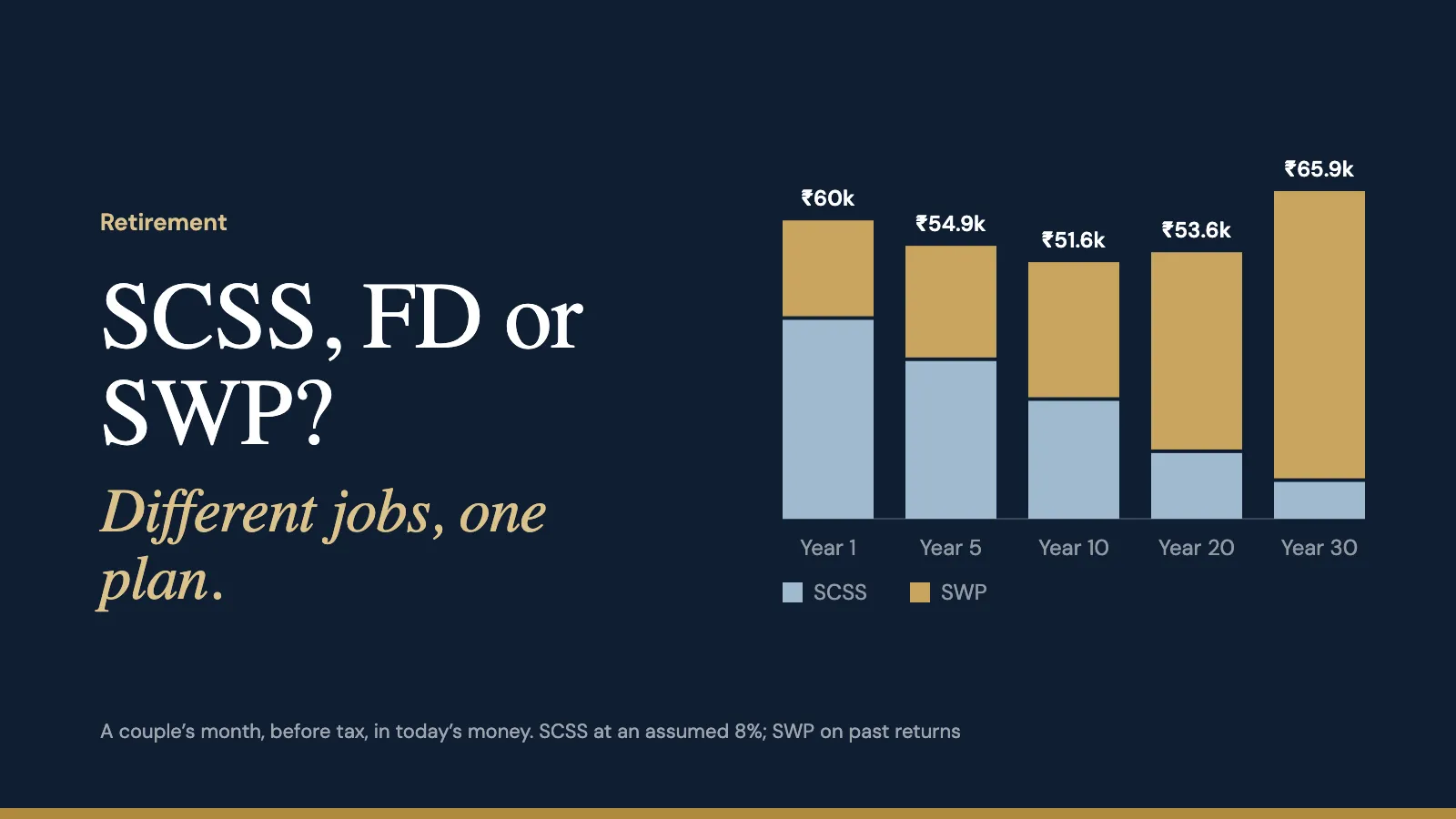
Say you’re both over 60, with ₹1.2 crore between you. Your emergency money and health cover are already separate. You’d like ₹60,000 a month to start.
- ₹60 lakh in SCSS, ₹30 lakh in each name. At an assumed 8%, chosen only to illustrate, each account pays ₹60,000 a quarter: ₹1.2 lakh between you, about ₹40,000 a month.
- ₹60 lakh in a 50:50 mix of funds, paying ₹20,000 a month through an SWP. Because the SCSS part stays flat, we let the SWP part rise 10% a year, faster than prices.
| Year | SCSS interest, both of you | SWP from ₹60 lakh | Total a month | Total in today’s money |
|---|---|---|---|---|
| 1 | ₹40,000 | ₹20,000 | ₹60,000 | ₹60,000 |
| 5 | ₹40,000 | ₹29,300 | ₹69,300 | ₹54,900 |
| 10 | ₹40,000 | ₹47,200 | ₹87,200 | ₹51,600 |
| 20 | ₹40,000 | ₹1,22,300 | ₹1,62,300 | ₹53,600 |
| 30 | ₹40,000 | ₹3,17,300 | ₹3,57,300 | ₹65,900 |
Before tax. SCSS at an assumed 8%, renewed at the same rate (it won’t be exactly that), paid quarterly and shown as a monthly average. SWP on the actual past monthly returns of our model portfolio: four equity funds and two debt funds held 50:50, over a 10-year window repeated across 30 years. Today’s money at 6% inflation. Past performance may or may not be sustained in future.
What the numbers show:
- The SWP part lasts all 30 years on those past returns, and leaves ₹10.2 crore, about ₹1.78 crore in today’s money. That’s a replay of one good decade, not a forecast.
- The order of returns didn’t break it. Replayed from each of the 120 months in the window, it lasted every time.
- Lower returns would. With every fund earning 3 percentage points a year less, it runs out in year 28.
- From an FD instead, the same ₹20,000 rising 10% a year from ₹60 lakh runs out in year 18.
- Tax is light on the SWP early on. In year 1, its ₹2.4 lakh of withdrawals carry about ₹2,000 of tax on our assumptions. Each of you pays tax on ₹2.4 lakh of SCSS interest at your own slab rate.
Look at the last column. In today’s money, your total dips from ₹60,000 to a little over ₹51,000 between years 10 and 15, before the rising SWP part lifts it again. That dip is the flat SCSS income losing ground to prices. If it matters to you, start the fund part higher or raise it faster; both draw more from the funds, so test them before you commit. For what ₹50 lakh or ₹1 crore can pay on its own, see monthly income from ₹50 lakh or ₹1 crore.
The SCSS part did its job too. It paid two-thirds of your starting income whatever markets did, so in the first five years the funds only had to find ₹20,000 to ₹30,000 a month.
What to do next
Try your own split in the SWP calculator: it shows how long the fund part lasts, the tax and what’s left, next to an FD. Our retirement income page explains how we keep the next three years outside the market. To see how plans like this come together for different starting points, read situations like yours, or take the retirement readiness check to see where you stand.
When you’d like a second pair of eyes, book a review call.