Business cash
How a Company’s Mutual Fund Gains Are Taxed (2026)
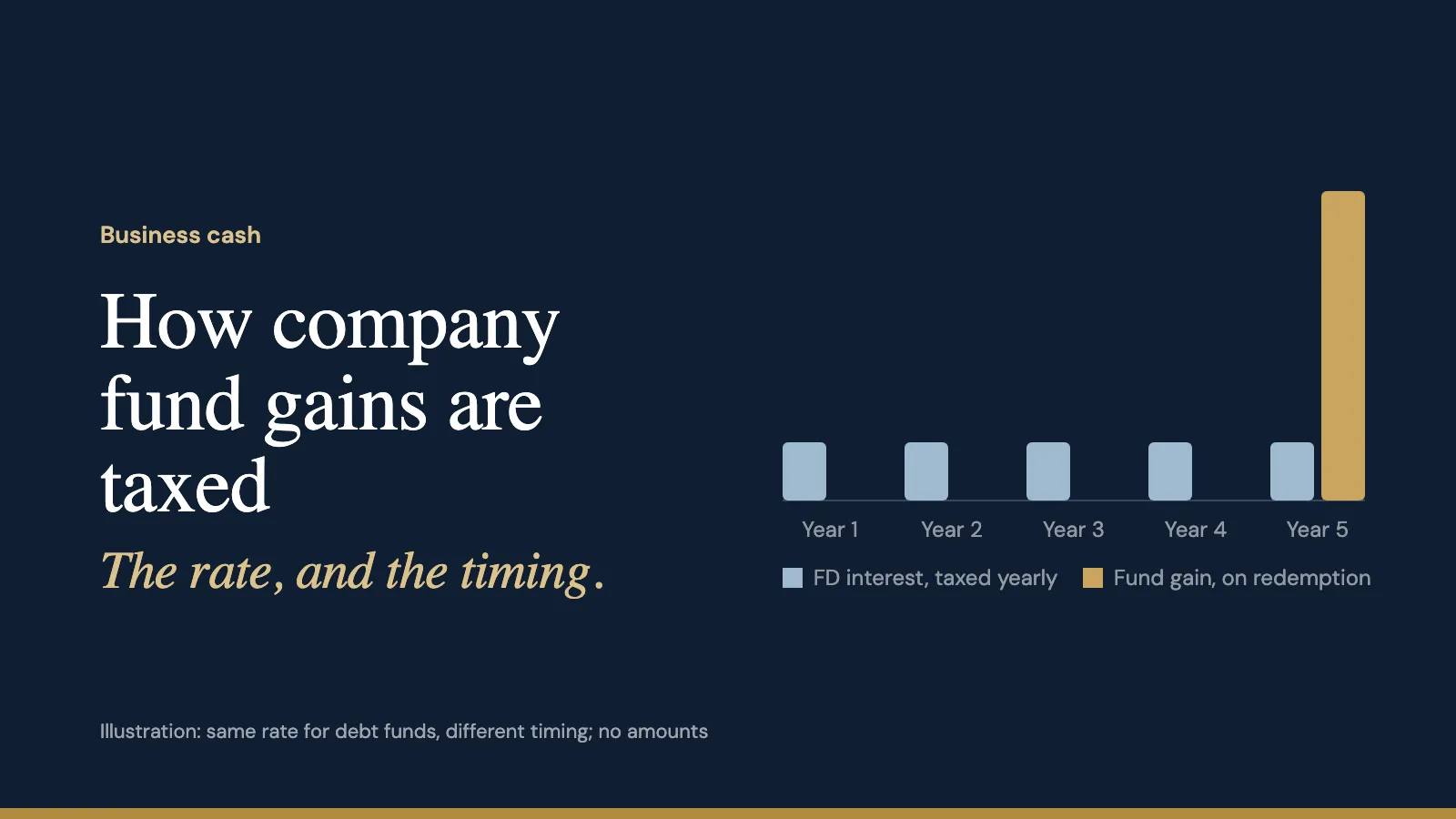
A company’s FD interest is taxed every year. Its liquid fund gains are taxed only when the units are sold, at the same rate. Here is how each kind of fund is taxed for a company or firm, when the tax falls due, and how it sits in the books.
· 8 min read
Your company has put some spare cash into a liquid fund. Then your CA asks a question you never had to think about with FDs: when is this taxed, and at what rate?
Here is the answer for 2026, for private limited companies, LLPs and partnership firms. One thing first. The Income-tax Act, 2025 replaced the 1961 Act from 1 April 2026. Section numbers changed and “previous year” became “tax year”, but the rates and rules below carried over. If your CA mentions an old section number, the rule behind it is the same.
The short answer
- Liquid, overnight and money market funds (units bought from April 2023): gains are taxed as short-term capital gains at the entity’s own rate, however long the units were held.
- Arbitrage funds are taxed as equity: 20% on gains from units held up to 12 months, 12.5% after that, plus surcharge and cess.
- FD interest is taxed every year, as it accrues. Fund gains are taxed only when you redeem. For debt funds the rate is the same. The timing is not.
- Have your CA confirm how this applies to your entity. The rate depends on the tax regime your company has chosen.
How are liquid, overnight and money market fund gains taxed?
The law has a name for these: a specified mutual fund. It means a fund that puts more than 65% of its money into debt and money market instruments. Liquid funds, overnight funds and money market funds hold almost nothing else, so they are squarely in.
For units bought on or after 1 April 2023, the gain on redemption is treated as a short-term capital gain, whatever the holding period. There is no long-term rate and no indexation. In practice the gain is taxed at the same rate as the entity’s other income:
- A company on the concessional 22% regime pays 22%, plus a flat 10% surcharge and 4% cess: about 25.17% in all.
- A company on the older regime pays 25% or 30%, depending on its size, plus surcharge and cess. It may also have minimum alternate tax to think about.
- A partnership firm or LLP pays its own flat rate (more on that below).
The Income Tax Department’s website (incometax.gov.in) lists the current rates for domestic companies. Your CA will know which regime yours is on.
Units bought before April 2023 follow older rules. If the company still holds any, ask your CA to look at those separately.
How are arbitrage fund gains taxed for a company?
An arbitrage fund buys shares and, at the same moment, sells the same shares for a future date at a slightly higher price. It earns that gap, not the market’s rise. Because at least 65% of it is in shares, it is taxed as an equity fund, even though its returns tend to follow short-term interest rates.
- Units held up to 12 months: 20% on the gain.
- Units held for more than 12 months: 12.5% on the gain.
- In both cases, the entity’s surcharge and cess are added.
How much this matters depends on your own rate. For a firm paying a flat 30%, the gap between 30% and 20% is wide. For a company on the 22% regime, it is much narrower. Arbitrage funds also tend to charge an exit load if you sell within about a month, and their value can dip over very short periods. So they suit money parked for a few months, not a few weeks.
What about the ₹1.25 lakh exemption on equity gains?
Individuals pay no tax on the first ₹1.25 lakh of long-term equity gains each year. Does that extend to a company or a firm? Check with your CA whether it applies to your entity. Either way, next to the sums a business parks, it is a small part of the picture.
FD interest or fund gains: when is each taxed?
For debt funds, the difference is timing, not rate.
A company’s FD interest is taxed every year, as it accrues. That holds whether the interest is paid out or added to a cumulative FD, and whether or not the company can touch the money. Margin FDs held by your bank are included. The bank usually deducts TDS as well.
A fund pays no interest. Its value rises. Nothing is taxed until the units are redeemed or switched, and then the whole gain since purchase is taxed in that tax year.
Say the company keeps ₹50 lakh aside for two years. In an FD, the tax on each year’s interest is paid that year, through TDS and advance tax. In a liquid fund redeemed after two years, the tax on both years’ gain is paid in the second year.
Be clear about what that does and doesn’t do:
- The tax isn’t lower. On a debt fund it is the same rate as FD interest.
- It is paid later. The money that would have gone in tax stays invested in the meantime.
- It only helps across year-ends. Buy and redeem within the same tax year and there is no deferral at all.
- The rate is the one in force when you redeem. If rates or your regime change before then, that could work either way.
- A fund isn’t a deposit. A liquid fund is among the lowest-risk funds, but its value isn’t guaranteed or insured.
| What the company holds | When it’s taxed | How it’s taxed |
|---|---|---|
| Bank FD, including margin FDs | Every year, as interest accrues | As income, at the entity’s rate; the bank usually deducts TDS |
| Liquid, overnight or money market fund (bought from April 2023) | When units are redeemed or switched | As a short-term capital gain at the entity’s rate, any holding period |
| Arbitrage fund | When units are redeemed or switched | As equity: 20% if held up to 12 months, 12.5% after; plus surcharge and cess |
| IDCW paid by any fund | When it’s paid | As income, at the entity’s rate; TDS may apply |
Rules for the 2026–27 tax year. Tax rules change with budgets; check with your CA.
Is it different for a partnership firm or LLP?
The rules are the same. Debt fund gains are taxed on redemption at the entity’s rate; arbitrage fund gains at the equity rates. What changes is the rate itself.
A partnership firm or LLP pays a flat 30%, plus a surcharge if its income is above ₹1 crore, and cess. It can’t opt into the concessional 22% regime, which is for companies. So for a firm, the gap between debt fund and arbitrage fund taxation is wider than for most companies.
The practical steps are much the same too. The firm invests in its own name and PAN, with a partners’ authorisation instead of a board resolution. How to set that up is covered in can a private limited company invest in mutual funds?
Do mutual funds deduct TDS on a company’s gains?
Not on capital gains for a resident company or firm. The fund pays out the full redemption amount, and the entity pays any tax due itself, through advance tax. That is different from an FD, where the bank deducts TDS on the interest.
IDCW payouts are another matter. The fund may deduct TDS on them above a yearly threshold. Non-resident investors have separate rules, not covered here.
How do fund gains affect advance tax?
Companies and firms pay advance tax in four instalments: 15% of the year’s tax by 15 June, 45% by 15 September, 75% by 15 December and all of it by 15 March. Gains booked on redemptions during the year are part of the year’s income, so they belong in those instalments.
Capital gains are hard to predict, so the rules give some room. Tax on a capital gain that arises after an instalment date can be paid in the instalments that remain, without interest for the earlier ones. A large redemption in October, for example, belongs in the December instalment.
Two habits help. Tell your CA about redemptions each quarter, not at year-end. And keep the capital gains statement the fund registrars (CAMS and KFintech) issue, which shows every redemption and its gain. The March tax checklist covers the last instalment and what to time around 31 March.
How to show mutual fund investments in the balance sheet
This one is for your auditor to decide, and worth agreeing before the first year-end. In general:
- Where it sits. Units the company expects to redeem within a year usually go under current investments, in current assets. The company balance-sheet format in Schedule III to the Companies Act has a separate line for investments in mutual funds.
- How gains show up depends on your accounting standards. Under the standards most unlisted owner-led companies follow (AS 13, for investments), current investments are generally carried at the lower of cost and market value. A gain then reaches the profit and loss when the units are sold, while a fall below cost shows up at the year-end.
- Under Ind AS, which larger companies follow, fund units are usually measured at fair value. Gains then appear in the accounts as they build up, before they are taxed, and the gap between book and tax is handled through deferred tax. If your company is within minimum alternate tax, which works off book profit, that difference can matter too.
- Cash or investment? Whether any of it can be shown as a cash equivalent is a judgement for your auditor.
Partnership firms aren’t bound by Schedule III, but their accounts often follow similar principles. Their CA will set the format.
What to do next
Start with how much of the company’s cash isn’t needed for a while. The surplus cash calculator on our corporate treasury page works it out from your limits, the FDs held as margin and what you need over the next 90 days. Then take the figure to your CA with this page.
If you would like to go through the post-tax position with us and your CA before anything moves, book a review call.