Business cash
Liquid Fund, Sweep FD or Current Account for Business Cash
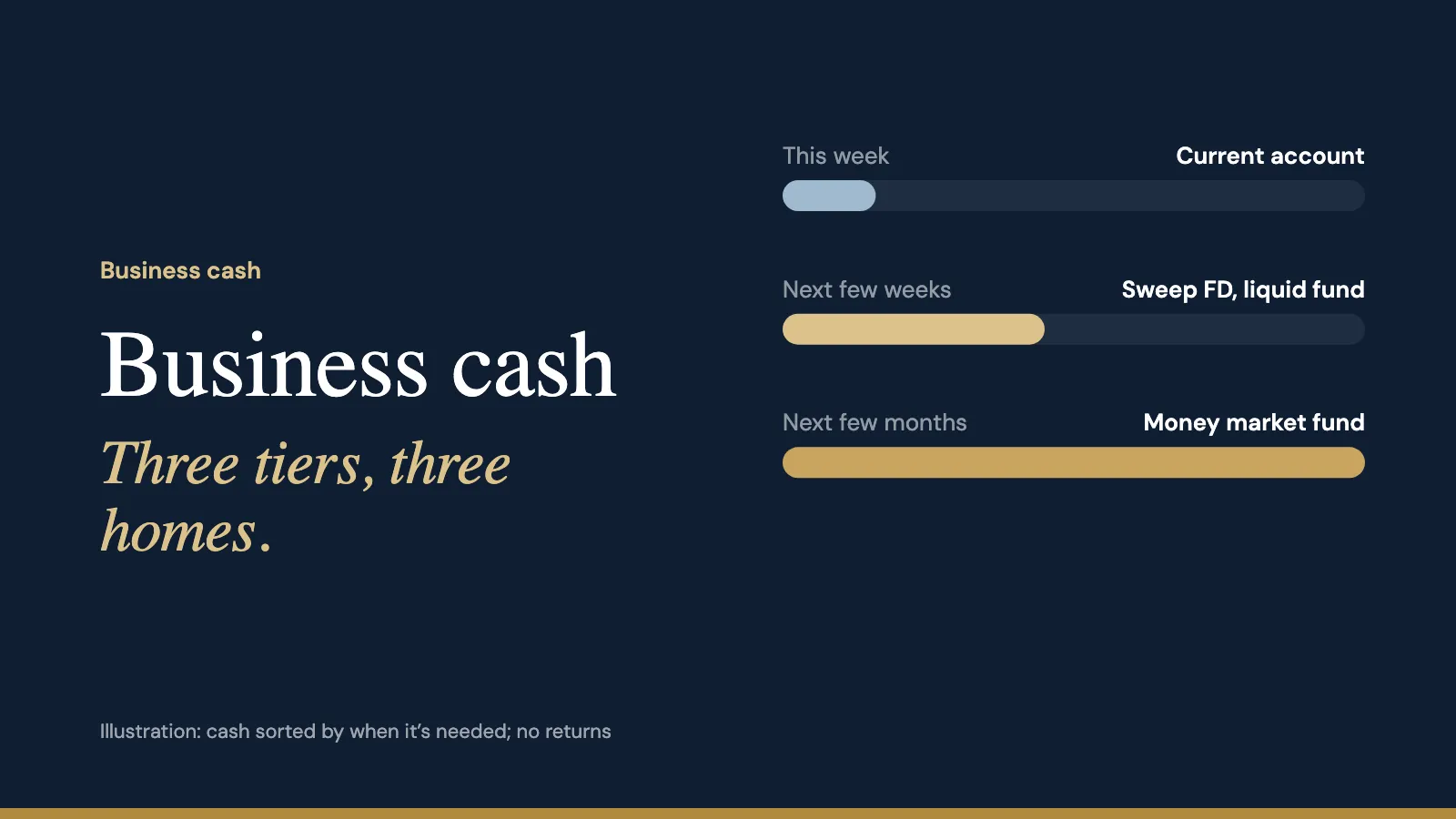
Most business cash has three jobs: this week’s payments, the next few weeks’ and the next few months’. A current account, a sweep FD and an overnight, liquid or money market fund each suit a different job. Here is how they compare, side by side.
· 7 min read
The money in your business’s bank account isn’t one pile of cash. Some of it pays salaries on Friday. Some of it pays a supplier next month. Some of it is set aside for the December advance tax instalment, or a machine you plan to buy in the new year.
Each of those has a different job, and there’s a different place that suits each one. Here is how a current account, a sweep FD and overnight, liquid and money market funds compare for a business, and how to write it all down on one page.
The short answer
- The current account is for what goes out in the next few days. It earns nothing, and it’s always there.
- A sweep FD earns FD interest on balances above a threshold, automatically, without leaving your bank. Its rules vary from bank to bank.
- Overnight, liquid and money market funds suit cash for the next few days, weeks and months, held in the business’s own name. Liquid and overnight fund redemptions are typically credited the next business day.
- None of these is better overall. Each suits a different slice of your cash, and many businesses use two or three.
What are the three tiers of business cash?
Operating cash. What goes out this week and next: salaries, suppliers, GST, EMIs, rent. It has to be there on the day, so it lives in the current account.
The next few weeks. Payments you know are coming, and a cushion for the customer who pays late. You need it soon, but not today.
The next few months. The next advance tax instalment, seasonal stock, a planned purchase, or cash left over after a large receipt. You won’t touch it for a while.
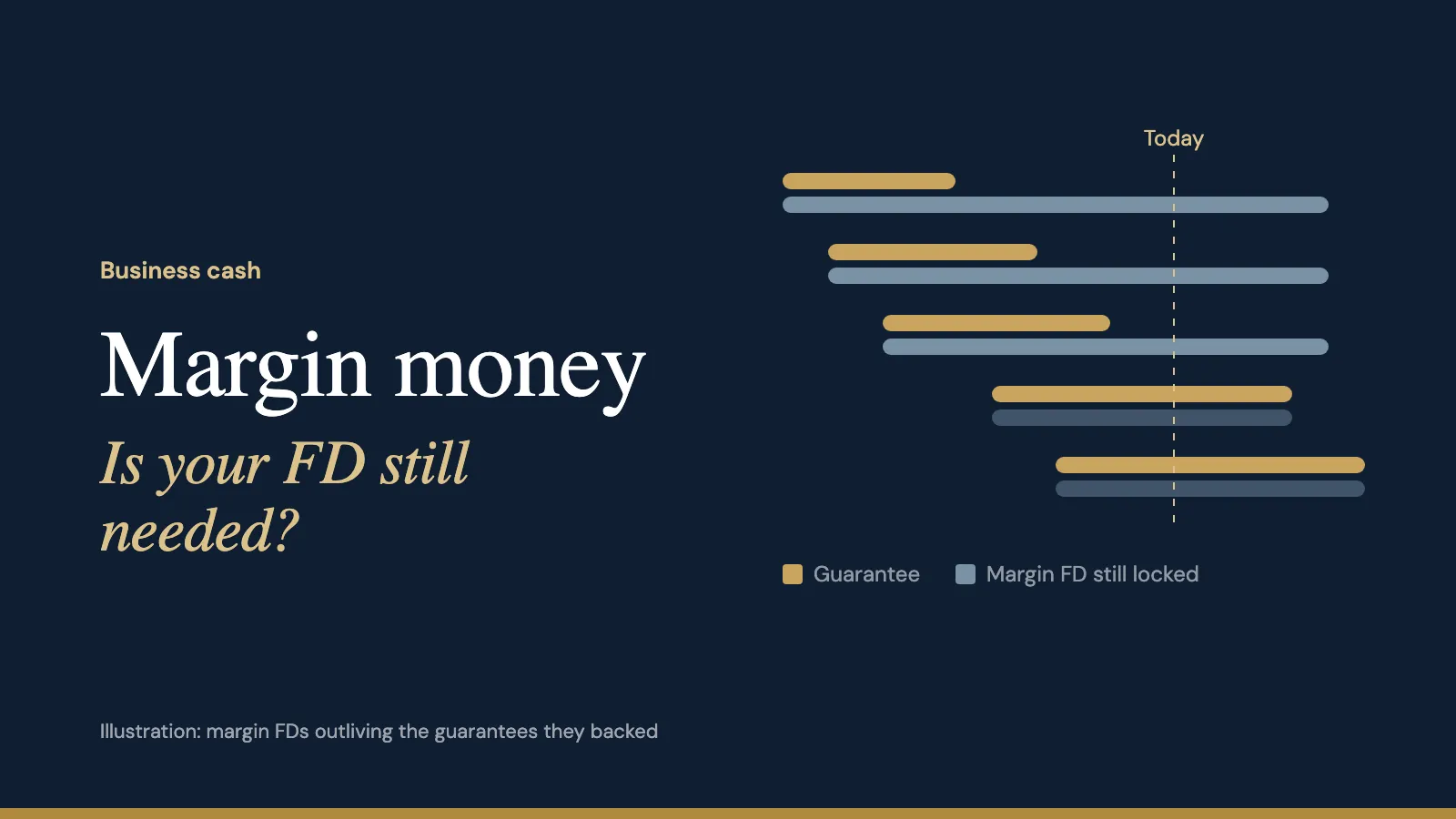
For each tier, ask two questions. How soon might we need it? And how much can its value move in the meantime? FDs held as margin for bank guarantees are a separate question: they can only move once your bank releases them.
What does each option actually do?
A current account pays no interest. The RBI doesn’t allow banks to pay interest on current accounts. What you get is instant access: payments, cheques, transfers, all day.
A sweep FD (also called auto-sweep or sweep-in) links your current account to FDs. Above a threshold you agree with the bank, the surplus is moved into an FD automatically. When the account falls short, part of the FD is broken and swept back. You earn FD interest on the swept part, for the time it stays swept. The rules vary by bank: the threshold, the FD’s term, the size of each unit swept, which deposit is broken first, and whether breaking early lowers the rate. Ask for them in writing.
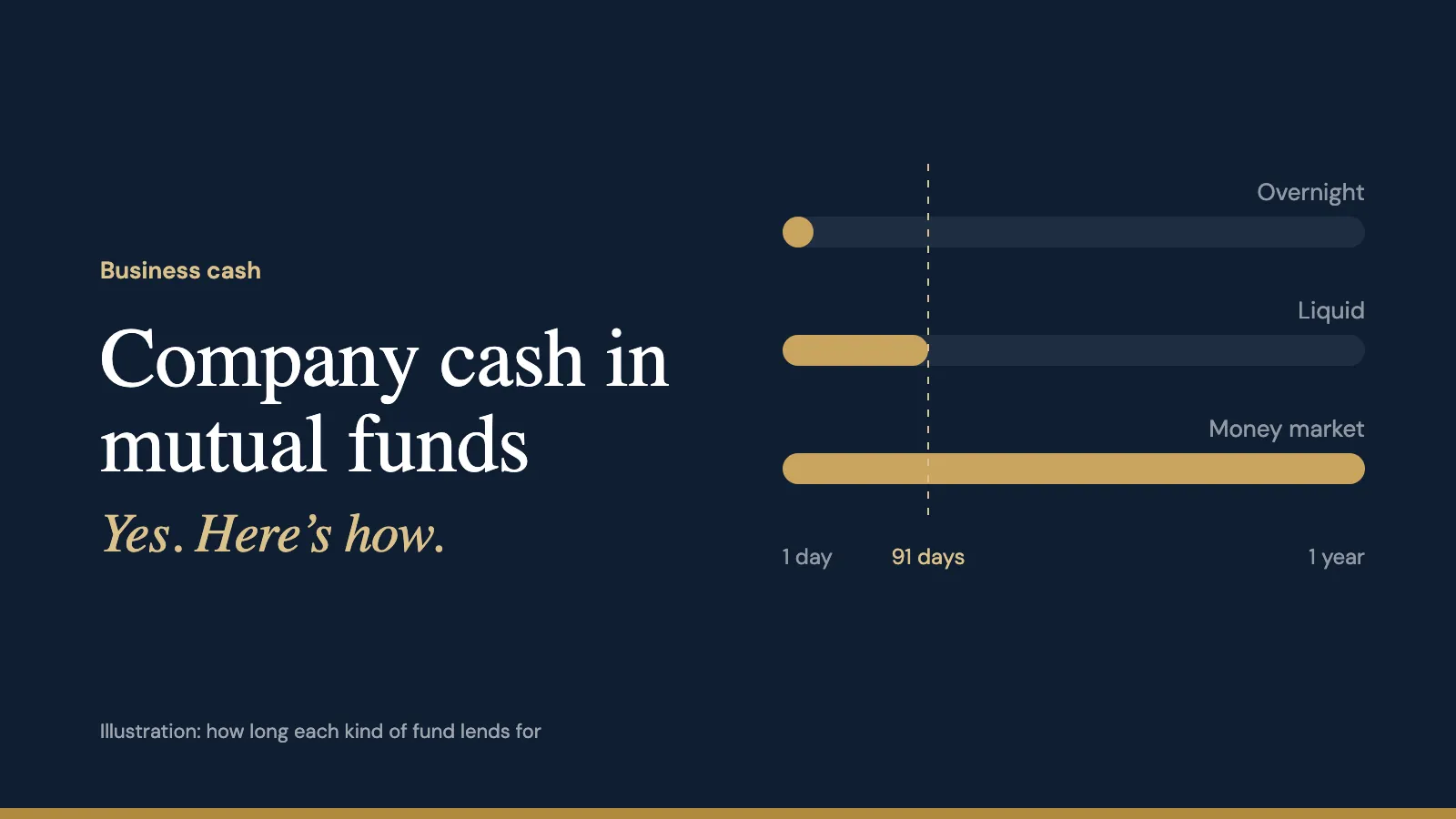
An overnight fund lends for one day at a time, mostly against government securities. It’s the lowest-risk mutual fund category, though not guaranteed. Its return follows the overnight rate, day by day.
A liquid fund lends for up to 91 days, to the government, banks and large companies, and keeps at least 20% in cash-like assets to meet redemptions. It usually earns a little more than an overnight fund, with a little more risk.
A money market fund lends for up to a year. That usually earns a little more again, and its value moves a little more when interest rates change.
None of the three funds is a deposit. They aren’t guaranteed or insured, and each scheme shows a riskometer and Potential Risk Class worth reading before you invest.
How quickly can a business get its money back?
Current account: immediately.
Sweep FD: usually automatically, when the current account needs it, under the bank’s own rules.
Liquid and overnight funds: SEBI sets uniform cut-off times. A redemption request received by 3 pm on a business day is processed that day, and the money is typically credited the next business day. After 3 pm, it moves a day later. For overnight funds, SEBI has also allowed a later cut-off for redemptions placed online. On the way in, money that reaches the fund by 1:30 pm starts earning from that day. Each scheme’s documents set out its cut-off times in full.
Exit loads: a liquid fund charges a small, falling exit load if you redeem within six days of investing, and none from the seventh day. Overnight funds usually charge none.
Money market funds: redemptions usually arrive within one or two business days. Many charge no exit load; check the scheme’s documents.
Two practical points. First, some liquid and overnight funds offer instant redemption, but only to resident individual investors. A company or firm can’t use it, so plan on the next business day. Second, place redemptions a working day or two before the payment is due, and watch for bank holidays. SEBI’s outer limit for paying any redemption is three working days, but liquid and overnight funds typically pay much sooner.
How is each one taxed for a business?
Current account: nothing to tax.
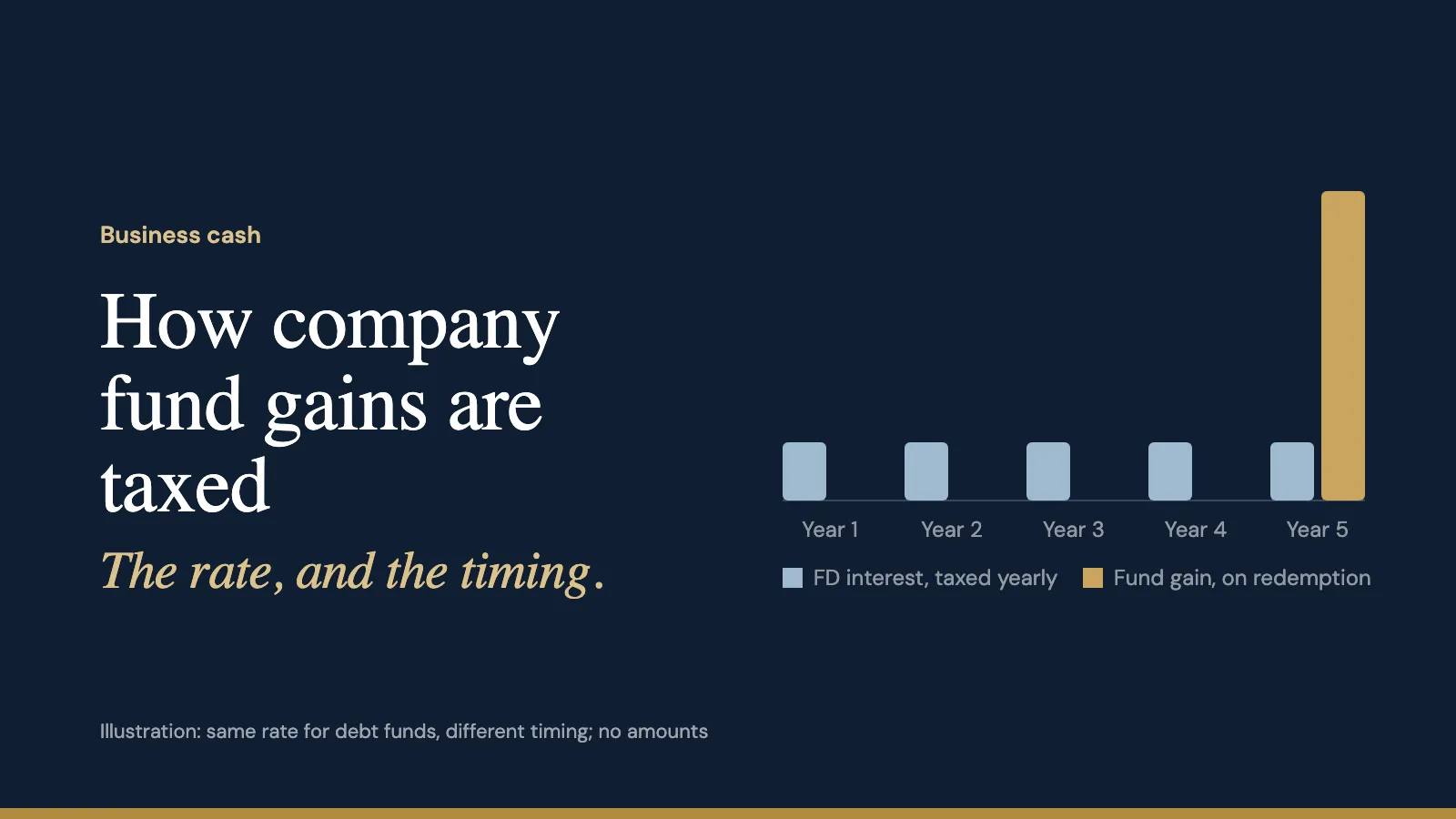
Sweep FD: the interest is taxed every year, as it accrues, at the business’s own rate. The bank usually deducts TDS.
Overnight, liquid and money market funds (units bought from April 2023): nothing is taxed while the units are held. Gains are taxed only on redemption, as short-term capital gains at the business’s own rate, however long the units were held.
So for these funds, the rate is the same as FD interest. What differs is when the tax is paid. That’s a matter of timing, not a lower tax, and it only matters when money is held across a year-end. The detail, including arbitrage funds and how gains sit in the books, is in how a company’s mutual fund gains are taxed. Tax rules change with budgets; check with your CA.
Who can redeem, and where does the money go?
This is where a sweep FD is simplest: it’s inside your bank, under the mandate you already have. Funds need a little setting up, once.
- The investment is in the business’s own name and PAN, with its own KYC. A company needs a board resolution naming who may invest and redeem; a firm, its partners’ authorisation. How to set that up is covered in can a private limited company invest in mutual funds?
- Money goes in only from the business’s own bank account. Funds don’t accept payments from third parties.
- Redemptions are paid only to the bank account registered with the fund. They can’t be sent to a supplier, a director or anyone else. That’s a safeguard, but it means a change of bank account takes paperwork and time. Do it well before you need the money.
- Decide who does what. A common split: one person places a redemption, a second approves it, and a third reconciles the statements.
- Reconcile every month against the consolidated account statement from the fund registrars, CAMS and KFintech.
What goes in a one-page treasury policy?
Write it once, have the board or partners approve it, and review it. One page is enough:
- Tiers and limits. How much stays in the current account, in days or weeks of outgoings. What goes in each of the other tiers.
- What’s allowed. For example: current account, sweep FD and FDs, and overnight, liquid and money market funds. Anything else needs the board’s approval.
- Spread. The most in any one bank, fund house or scheme.
- Who approves. Who can invest and redeem, up to what amount, and who signs off above it.
- Timing. How many working days before a payment a redemption is placed, and the cut-off times to respect.
- Review. The cash map, monthly. The policy itself, every quarter, before the advance tax dates. The whole thing, yearly, with your CA.
- Reporting. A short monthly note to the owners: what’s where, what it earned, and anything that broke the policy.
Side by side
| Option | Earns | Money back | Tax | Suits |
|---|---|---|---|---|
| Current account | Nothing | Immediately | Nothing to tax | This week’s payments |
| Sweep FD | FD interest on the swept part | Swept back under the bank’s rules | Interest taxed yearly, as it accrues | Balances above your threshold |
| Overnight fund | The overnight rate, day by day | Typically next business day | Gains taxed on redemption | Days |
| Liquid fund | Short-term rates, loans up to 91 days | Typically next business day; small load in the first 6 days | Gains taxed on redemption | Weeks to a few months |
| Money market fund | Short-term rates, loans up to a year | Usually one or two business days | Gains taxed on redemption | A few months to a year |
Fund gains as taxed for units bought from April 2023. Bank deposits are insured up to ₹5 lakh per depositor per bank; mutual funds aren’t guaranteed or insured.
What to do next
Start by sorting your cash into the three tiers. The surplus cash calculator shows how much of it you won’t need for the next 90 days, from your limits, your FDs and your known payments.
Our corporate treasury page sets out how we work alongside your bank and CA. When you’d like to go through your own numbers, book a review call.