Business cash
Can a Private Limited Company Invest in Mutual Funds?
Yes, and so can an LLP, a partnership firm, a One Person Company or a Section 8 company. Here's who signs, what the board resolution should say, the KYC documents, and where each part of your business's cash can go.
· 9 min read
Your business has cash it won’t need for a while. It sits in the current account between payment cycles, in FDs that renew themselves, or with the bank as margin for a guarantee. You’ve heard that companies park cash in mutual funds, and you want to know whether yours can, and what it takes.
It can. Here’s who signs, what the paperwork looks like, and where each part of the cash fits.
The short answer
Yes. A private limited company can invest in mutual funds in its own name, and so can most other kinds of business:
| Your business | Can it invest? | Who signs | Key documents |
|---|---|---|---|
| Private or public limited company | Yes, in its own name | Signatories named in a board resolution | Board resolution, certificate of incorporation, MoA and AoA |
| One Person Company (OPC) | Yes, in its own name | Its director, under a board resolution | As for a private company |
| Section 8 company | Yes, in its own name, after checking its tax rules | Signatories named in a board resolution | As for a company |
| LLP | Yes, in its own name, if the LLP agreement allows | Designated partners, authorised by the partners | Partners’ resolution, certificate of incorporation, LLP agreement |
| Partnership firm | Yes, in the firm’s name | Partners authorised by the deed or by the partners | Partnership deed, registration certificate if registered, authorisation |
| Sole proprietorship | Only as the proprietor, an individual | The proprietor | The proprietor’s own PAN and KYC |
Every business that invests in its own name also needs its PAN, entity KYC, a beneficial-owner declaration, a FATCA/CRS declaration and proof of its bank account.
Two more things up front:
- Match the cash to when you’ll need it. Most business cash belongs in overnight, liquid and money market funds, not the stock market.
- FDs held as margin stay where they are until your bank says otherwise, in writing.
What each type of business needs
Private and public limited companies. Investing the company’s funds is a board decision, so everything starts with a board resolution (more on it below). The fund house will want a certified copy, with the signatory list and the company’s constitution.
One Person Companies. An OPC is a private company with its own legal identity, so it invests like any other company. If it has a single director, the resolution can be entered in the minutes book and signed by that director instead of being passed at a meeting.
Section 8 companies. A not-for-profit company can invest its surplus in its own name, with a board resolution, like any company. But if it’s registered as a charity for income tax, the law limits the forms in which it can invest its funds if it wants to keep its exemption. Check with its CA which investments qualify before anything moves.
LLPs. An LLP invests in its own name, if its LLP agreement allows it, with a resolution of the partners naming the designated partners who can sign.
Partnership firms. A firm invests in its own name and PAN, with the partnership deed (and its registration certificate, if it’s registered) and an authorisation naming the partners who can act for it.
Proprietorships. A proprietorship isn’t a separate legal entity, so the proprietor invests as an individual, in their own name and PAN.
Non-individual KYC documents: the full list
KYC for a business is done once through a KYC registration agency and is usually recognised across fund houses. Expect to provide:
- The entity’s PAN and proof of its registered address.
- Its constitution: certificate of incorporation, MoA and AoA; or the LLP agreement; or the partnership deed.
- The board resolution or partners’ authorisation, and the list of authorised signatories with specimen signatures.
- KYC of each authorised signatory: PAN, photograph, and proof of identity and address.
- A declaration of beneficial owners, the people who ultimately own or control the business, with their KYC.
- A FATCA/CRS self-declaration of the entity’s tax residence.
- Proof of the bank account: a cancelled cheque or a recent statement.
Some also ask for recent financial statements, the shareholding pattern, or details of the directors in charge. The list varies a little; we check it with you before anything is signed.
The board resolution for investment in mutual funds: what it should say
Your company secretary (CS) will draft it in the company’s own form, so we don’t publish a template. But a board resolution for investment of surplus funds usually covers four things:
- The authority: that the company may invest its surplus funds in units of mutual fund schemes registered with SEBI, and redeem or switch them.
- The limits: an overall amount and, if the board wants them, limits by category. For example, that only overnight, liquid, money market and arbitrage funds are allowed.
- Who can act: the authorised signatories who can invest, redeem and sign KYC and other forms, and whether one or two must sign together.
- The bank account: the company account that payments come from and redemptions go to.
If the board hands the decisions to a committee or a managing director, the Companies Act asks the resolution to state the total amount that can be invested and the kind of investments allowed.
Many boards also approve a short investment policy alongside it: limits for each category and each fund house, redemptions only to the company’s own account, and a quarterly review of the holdings against the cash the business needs.
What the Companies Act says
Three sections come up:
- Section 179(3)(e). The power to invest the company’s funds is one the board exercises by resolution at a board meeting. That’s why the resolution above comes first.
- Section 186. It limits a company’s loans, guarantees and investments in the securities of other bodies corporate. Above the larger of 60% of paid-up capital, free reserves and securities premium, or 100% of free reserves and securities premium, shareholders must approve by special resolution. Many company secretaries take the view that it doesn’t cover mutual fund units, because a mutual fund is set up as a trust, not a body corporate. It isn’t a settled point, so confirm the position with your CS.
- Section 187. A company’s investments are made and held in its own name. Units bought with company money belong in the company’s folio, never a director’s.
Where to invest company money: which fund fits which cash
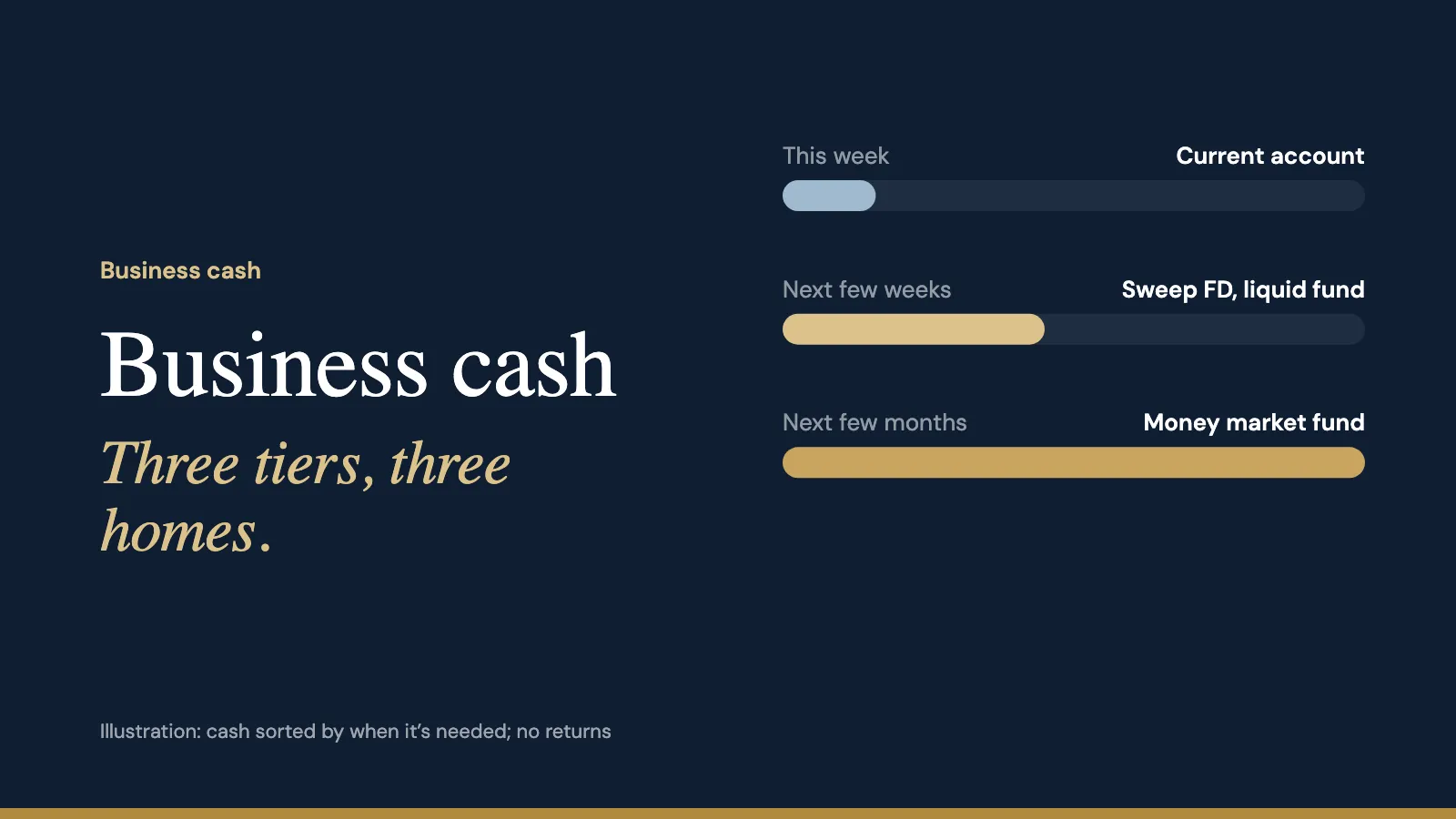
Start with a cash map, not a product. Write down what the business must pay and when: salaries and GST dates in the next few days, running costs over the coming weeks, advance tax and planned purchases over the coming months. Then each part goes where its timing fits:
| When you’ll need it | Where it can sit | Why |
|---|---|---|
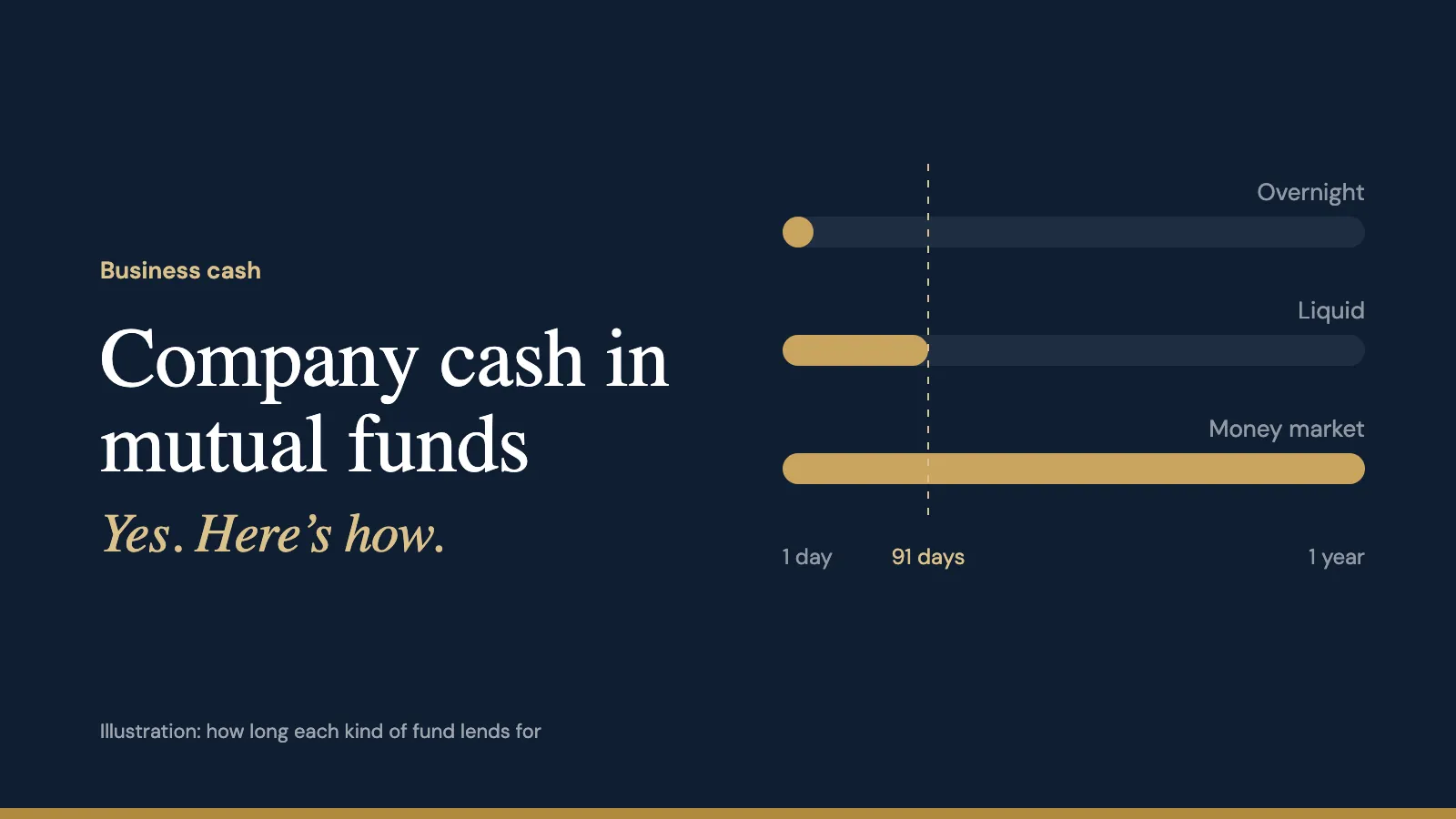
| Within days | Current account, or an overnight fund | Lends for one day at a time |
| Within about three months | Liquid fund | Lends for up to 91 days; usually paid out the next business day |
| Three to twelve months | Money market fund | Lends for up to a year; a little more movement in value |
| Three months or more | Arbitrage fund | Taxed as equity; usually an exit load in the first month or so |
Liquid funds charge a small exit load on money taken out within six days of investing, so cash you’ll need within the week fits an overnight fund better. Equity funds are a different decision altogether: their value can fall sharply, and cash the business relies on doesn’t belong there.
None of these funds is guaranteed or insured. A borrower defaulting can cut a fund’s value, and when interest rates rise, funds that lend for longer dip more. Liquid funds’ returns typically track short-term interest rates, so they fall when rates fall. Each scheme shows its riskometer and Potential Risk Class: check both, and read the scheme documents.
To see how this comes together for a manufacturer and a trading firm, look at the illustrations on our situations page.
Margin FDs and bank guarantees: ask the bank first
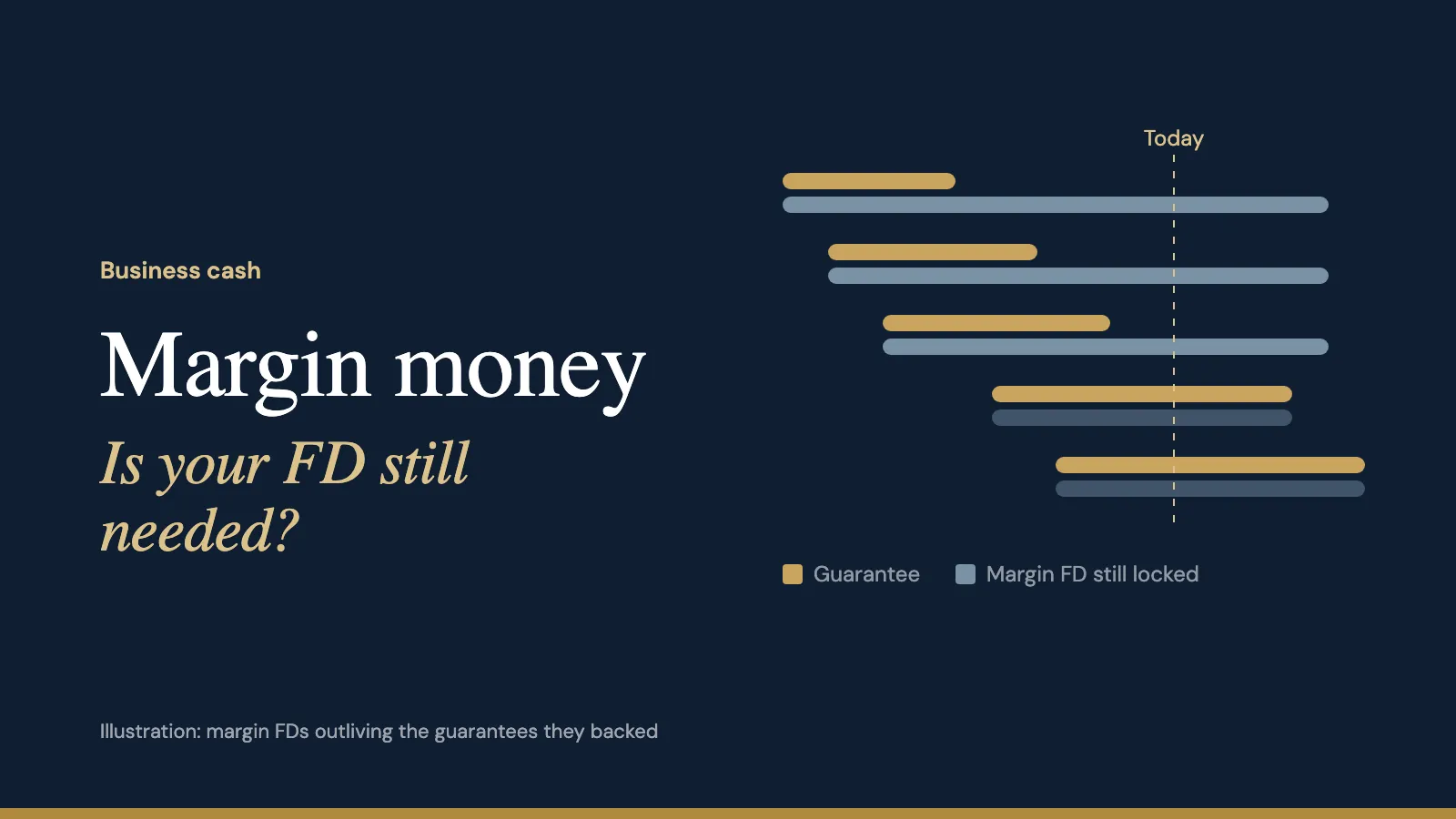
FDs held as margin for bank guarantees and letters of credit are often the biggest pool of idle cash, and the one to handle most carefully, because they’re pledged to the bank.
Take the example in our surplus cash calculator. A company with ₹5 crore of guarantee and LC limits keeps ₹1.4 crore in FDs as margin, 28% of its limits. At 6.5%, those FDs earn ₹9.1 lakh a year before tax. The company expects to need ₹80 lakh over the next 90 days, which leaves ₹60 lakh it won’t need for at least three months. (These are the calculator’s default figures, with the FD rate assumed.)
Whether any of that ₹60 lakh can move is the bank’s call. Some banks accept a lien on mutual fund units as margin instead of FDs, usually after a haircut: they count only part of the units’ value. Ask your bank, in writing:
- Will it accept a lien on fund units as margin, and with what haircut?
- Would the margin it asks for on each guarantee or LC change?
- Is there a penalty for closing the FDs early?
- Will your limits, pricing and terms stay exactly as they are?
We’re a mutual fund distributor, not a lender, and we don’t arrange credit. Your banker and your limits stay as they are, and nothing moves until the bank has confirmed in writing.
From KYC to first purchase: the steps
- The resolution. A board resolution passed at a board meeting, or the partners’ authorisation for a firm or LLP, with a certified copy and the signatory list.
- KYC. Entity KYC through a KYC registration agency, with the signatories’ and beneficial owners’ KYC and the FATCA/CRS declaration. If the business has done KYC before, it may only need updating.
- The folio. An application to the fund house with the resolution, signatory list and bank proof. This opens the company’s account with the fund, its folio, in its own name.
- The first purchase. The money goes from the company’s own bank account. Units are allotted at the NAV that applies when the money reaches the fund, measured against the fund’s cut-off times, not when the form was signed.
- After that. Review the statements each quarter against the cash map.
How long this takes depends mostly on how quickly the resolution and documents come together, and whether KYC is already in place, so start well before the cash arrives.
How is it taxed?
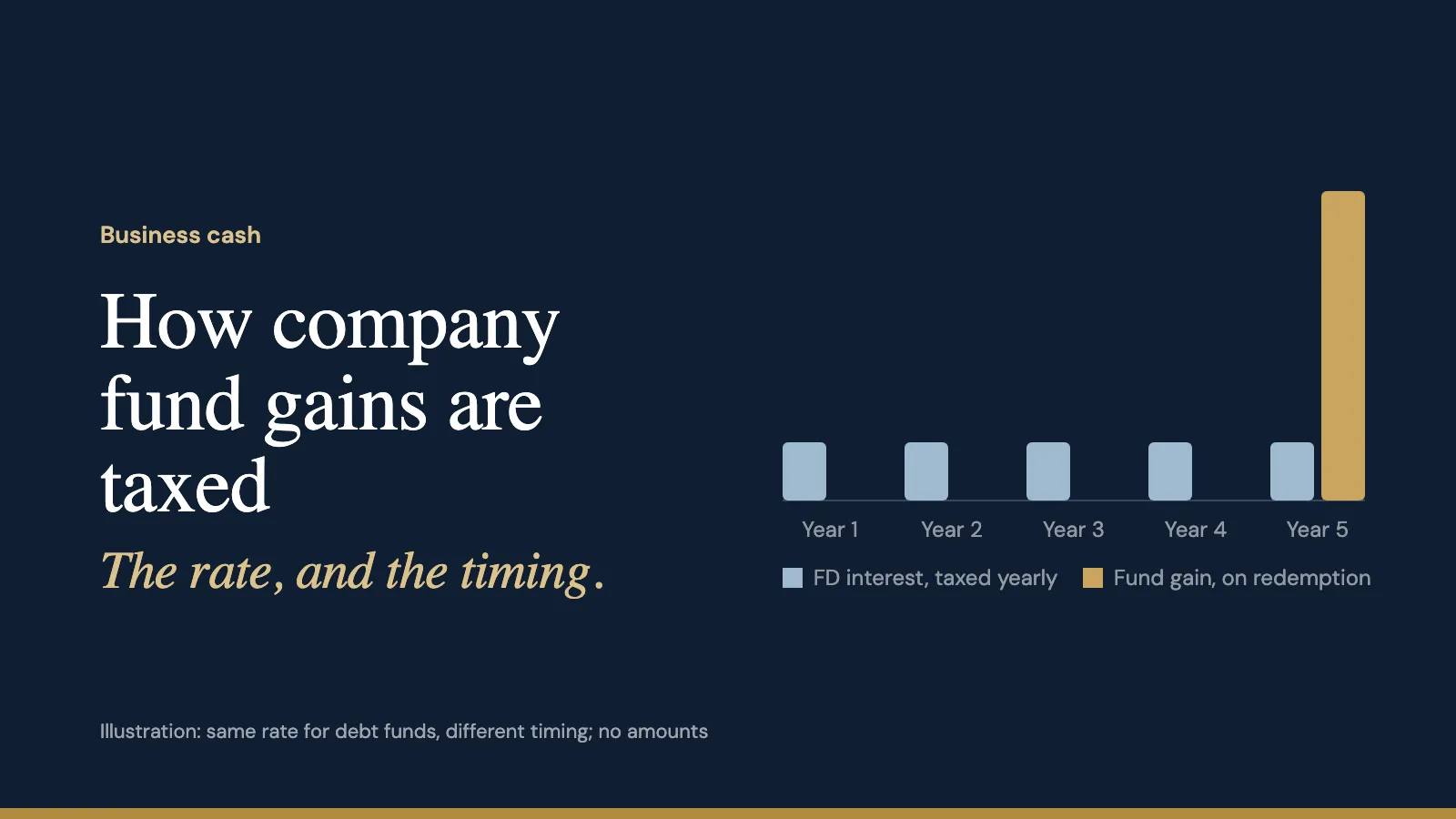
Briefly, and only at a general level. FD interest is taxed every year as it accrues, and the bank deducts TDS. Gains on debt funds bought from April 2023, which include overnight, liquid and money market funds, are taxed at the rate that applies to the business in the year the units are redeemed, with no long-term benefit however long they’re held. Arbitrage funds are taxed as equity funds.
Companies, LLPs and firms pay tax at different rates, so the comparison comes out differently for each. Tax rules change with budgets; check the position with your CA before anything moves.
What to do next
- Put your numbers into the surplus cash calculator: your limits, the FDs held as margin, and the cash you’ll need over the next 90 days.
- Draw up a cash map with your CA, and ask your CS about the resolution.
- Write to your bank with the four questions above.
When you’d like a second pair of eyes, book a review call and bring your CA along.