Business cash
Bank Guarantee Margin Money: Is Your FD Still Needed?
If your company gives bid and performance guarantees, some of its cash is probably sitting in FDs as margin, and some of those FDs may be backing guarantees that ended long ago. Here is how to find them, get them released, and what to ask your bank.
· 7 min read
If you build roads, supply a government department or bid for contracts, perhaps on the Amaravati capital works, you know the routine. A bid needs a bid guarantee. Winning needs a performance guarantee. And before the bank issues either, it usually wants margin: an FD it holds under lien.
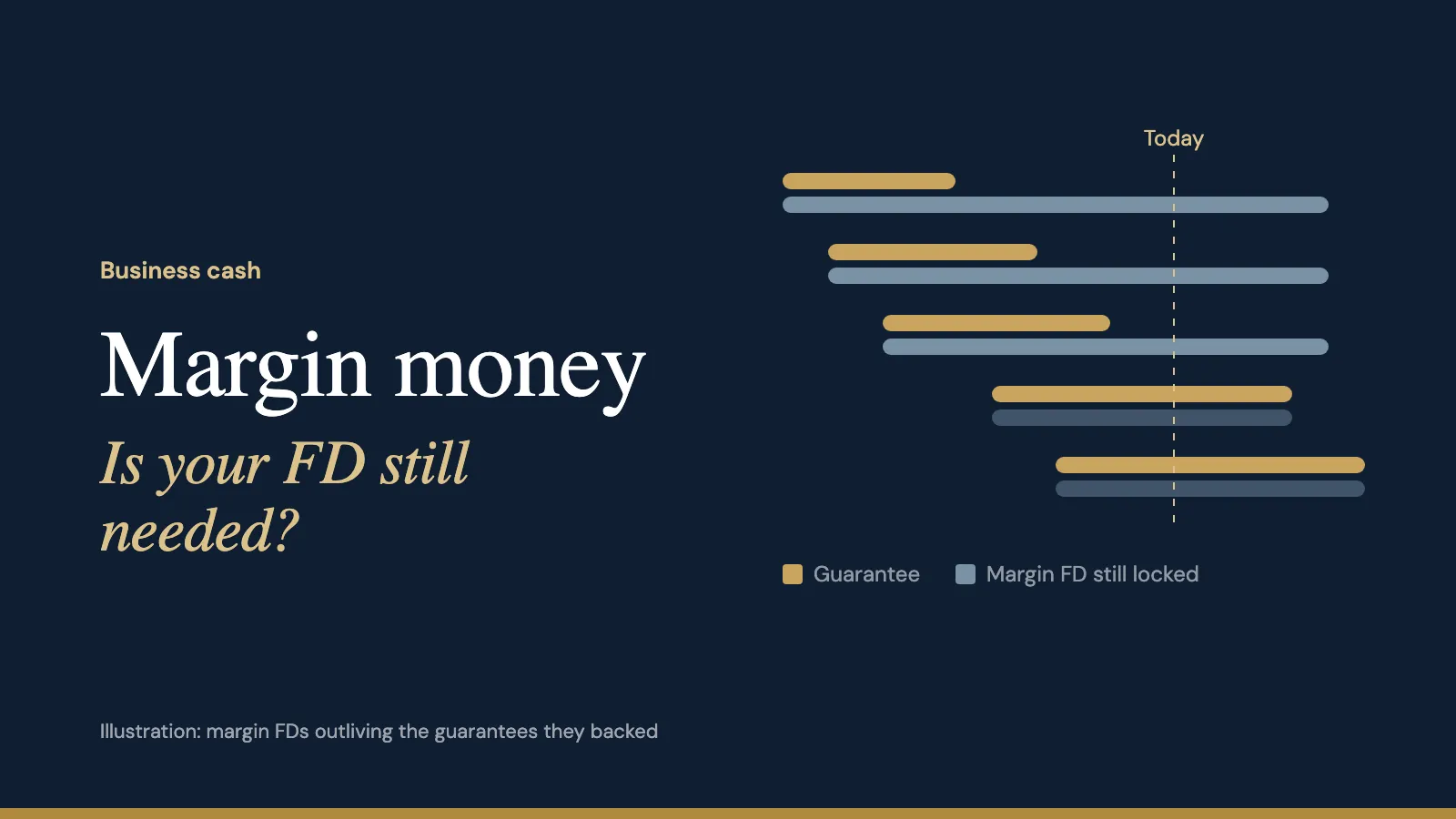
Years later, many of those FDs are still there. Some are backing live guarantees. Some are backing guarantees that ended long ago. Nobody is quite sure which is which.
The short answer
- Your bank sets the margin, case by case. There’s no single figure. It varies widely and can be as high as 100% of the guarantee for some customers.
- Margin often stays locked after a guarantee ends. Match every margin FD to a live guarantee. Get the expired ones cancelled and the lien lifted, in writing.
- Some banks accept a lien on mutual fund units as margin. Many don’t. Ask your own bank, in writing, before you plan around it.
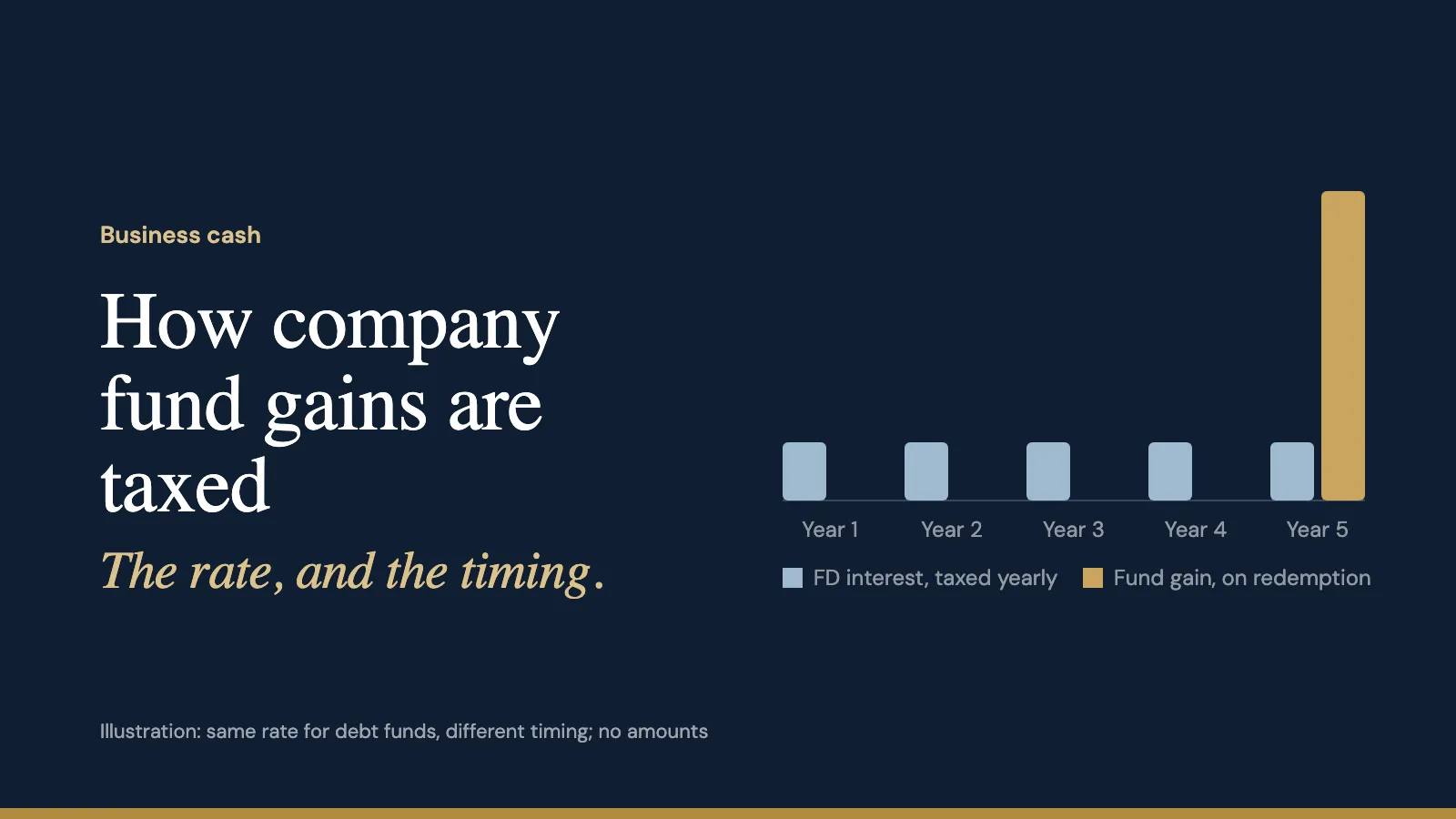
- Margin FD interest is taxed every year, like any FD interest, even though the company can’t touch the money.
How does bank guarantee margin money work?
A bank guarantee is your bank’s promise to pay the beneficiary, say a government department, a main contractor or a buyer, if you don’t perform. It’s a non-fund limit: no money leaves the bank unless the guarantee is invoked.
To cover that risk, the bank takes security. Part of it is often cash margin, a percentage of each guarantee held as an FD in your company’s name with a lien in the bank’s favour. Your company still owns the FD and earns its interest. It just can’t withdraw or break it.
The RBI doesn’t set one margin for ordinary bid and performance guarantees. Each bank decides under its own credit policy, and for each customer: its accounts, the collateral offered, the kind of guarantee, the track record. A long-standing customer with property as collateral may give little or no cash margin. A newer one may be asked for the full amount. The margin is usually written into your sanction letter, which means it can be discussed again at renewal.
Why does margin stay locked after a guarantee ends?
A guarantee’s work ending and its margin coming back are two different events. In between, things stall:
- The claim period. Many guarantees can still be invoked for a period after the expiry date. Banks often keep the margin until that has run out.
- The original never came back. Banks usually want the original guarantee returned, or a letter from the beneficiary releasing them. Departments and main contractors don’t always send either without a reminder.
- Auto-renewal. Margin FDs are often set to renew on maturity, so they roll over with the lien still marked, year after year.
- Nobody owns the job. The site team finishes the contract. The finance team doesn’t hear. The bank doesn’t chase.
- Margin taken in bulk. Where margin was taken against the limit as a whole, rather than guarantee by guarantee, it’s harder to see what each FD is backing.
How do you get margin money released?
It’s paperwork, done in a set order.
- Ask the bank for a statement of all outstanding guarantees and LCs, with amounts, expiry dates and claim dates.
- List every FD held under lien, with its amount, maturity date and the guarantee it backs, if anyone knows.
- Match the two lists. Any FD backing a guarantee that has expired, been returned or been cancelled is a candidate for release.
- For each one, collect the evidence. The original guarantee, or a discharge or no-claim letter from the beneficiary. Government departments can take time, so start early.
- Write to the bank asking it to cancel the guarantee in its books and lift the lien, naming the FD by number.
- Get the release in writing, and check the next FD statement shows no lien.
Then put the whole exercise on the finance team’s calendar every quarter, so it never builds up again.
Can a lien on mutual fund units replace a margin FD?
Sometimes. Some banks accept a lien on securities, including mutual fund units, as security for guarantees and other limits. Many don’t, or do only for some kinds of funds or some customers. Don’t assume it’s on offer. Ask.
Where a bank does accept it, the mechanics are straightforward. A lien is marked on the units in the bank’s favour through the fund’s registrar, or as a pledge through the depository if the units are held in demat. The units stay in the company’s name. Their value keeps moving with the fund, and the company can’t redeem them until the bank releases the lien. Banks usually apply a haircut, counting only part of the units’ value towards the margin, because a fund’s value isn’t fixed the way an FD’s is.
Put these questions to your bank in writing:
- Will you accept a lien on mutual fund units as margin for our guarantees, and for which kinds of funds?
- What haircut would you apply, and what happens if the units’ value falls?
- What margin do you require on each guarantee and LC today, and would that change?
- Would our sanctioned limits, commission and other terms stay exactly as they are?
- Is there a penalty for closing the margin FDs before they mature?
- How long does a substitution take, who signs it off, and what documents do you need?
Nothing should move until the answers are in writing. We are not a lender, and we don’t arrange credit or guarantees. Your banker stays, and your limits stay with them.
How is interest on a margin FD taxed?
Like any other FD interest. It’s taxed every year as it accrues, at the company’s or firm’s rate, even though the money is locked. The bank usually deducts TDS on it, which the company claims as a credit in its return. For a company on the concessional 22% regime, the tax works out to about 25.17% of the interest, including surcharge and cess.
Whether that interest counts as business income or as income from other sources has been argued in many tax cases, usually where it changes a deduction. Your CA will know which treatment applies to you. How it compares with fund gains, which are taxed only on redemption, is set out in how a company’s mutual fund gains are taxed.
A worked example: ₹1.4 crore of margin
This is the example company in our surplus cash calculator.
| The company’s numbers | Amount |
|---|---|
| Bank guarantee and LC limits | ₹5 crore |
| FDs held as margin | ₹1.4 crore |
| Margin as a share of limits | 28% |
| Interest a year on the margin, before tax | ₹9.1 lakh |
| Tax on that interest, at about 25.17% | ₹2.3 lakh |
| Cash the business needs in the next 90 days | ₹80 lakh |
| Cash not needed for 90 days | ₹60 lakh |
At an assumed 6.5% FD rate and the concessional 22% company rate with surcharge and cess. An illustration, not a forecast.
Read the last line carefully. Today, all ₹1.4 crore is margin. The ₹60 lakh is not an amount any bank has agreed to release. It’s the amount that, if released or substituted, the business wouldn’t need for at least the next 90 days.
That’s where the conversation with the bank starts. If the reconciliation turns up FDs backing expired guarantees, or the bank agrees to accept other security, the business keeps what it needs for the next 90 days where it can pay salaries and suppliers on time. Money not needed for that long could go, after a board resolution, into liquid or money market funds in the company’s own name, chosen for when it might be needed. A liquid fund lends for up to 91 days and typically pays redemptions the next business day. Unlike an FD, which is insured up to ₹5 lakh per depositor per bank, it isn’t guaranteed or insured.
There’s a composite of this situation, a family-run manufacturer near Mangalagiri with margin FDs nobody had looked at in years, on our client situations page.
A checklist for your finance team
- Bank’s statement of outstanding guarantees and LCs, with expiry and claim dates
- List of every FD under lien: amount, maturity, the guarantee it backs
- Each margin FD matched to a live guarantee; the rest flagged
- Originals or discharge letters chased for every expired guarantee
- Written request to the bank to cancel those guarantees and lift the liens
- Written confirmation of each release, checked against the next FD statement
- Auto-renewal instructions on margin FDs reviewed
- The bank’s written answers on margin, liens on fund units, haircuts and terms
- A 90-day map of the cash the business needs, done with your CA
- A board resolution in place before any money is invested
- The same review diarised every quarter, before the advance tax dates
If the company hasn’t invested in mutual funds before, can a private limited company invest in mutual funds? covers the resolution, KYC and who signs.
What to do next
Put your own limits, margin FDs and 90-day needs into the surplus cash calculator. It shows how much is locked, what it earns before tax, and how much you wouldn’t need for 90 days. It also lists what your bank has to confirm in writing first.
When you have the numbers, book a review call. Bring your CA if you like. Nothing changes until your bank has confirmed in writing how margin and limits would be treated.