Investing
Mutual Fund Distributor or Investment Adviser?
We are a mutual fund distributor, so you might expect us to tell you that you need one. Instead, here is how both kinds of help work, what each costs you, and when you would be better off without us.
· 7 min read
We’re a mutual fund distributor. So you might expect this article to explain why you need one.
Instead, here’s how both kinds of help work, what each one costs you, and when you’d be better off without us.
The short answer
- A mutual fund distributor (MFD) is registered with AMFI and holds an ARN. It’s paid commission by the fund house, out of the scheme’s expenses, and you invest through regular plans.
- A SEBI-registered investment adviser (RIA) charges you a fee directly and takes no commission. Its clients typically invest through direct plans, which cost less each year.
- The gap between a regular plan and a direct plan is, in the main, the distributor’s commission. Ours is typically 0.25% to 0.75% a year: ₹250 to ₹750 on every ₹1 lakh.
- Which suits you depends on the help you want, not just on which costs less on paper.
What’s the difference between a distributor and an RIA?
| Mutual fund distributor | SEBI-registered investment adviser | |
|---|---|---|
| Registered with | AMFI, with an ARN, after a NISM exam | SEBI, with a registration number starting INA |
| What it may do | Help you choose, buy and hold mutual funds, with advice incidental to that | Advise on your investments, as its main job |
| Who pays it | The fund house, from the scheme’s expense ratio | You, a fee agreed in advance |
| Plans you’d usually invest in | Regular plans | Direct plans |
A distributor’s advice is limited to what’s incidental to the schemes it distributes. An adviser’s can range wider. And SEBI keeps the two roles apart: a registered adviser can’t take commission on the products it recommends to you.
How does a mutual fund distributor earn?
Every scheme has a total expense ratio: the yearly cost of running it, taken out of the scheme’s assets before its NAV is worked out each day. You never get a bill for it. It’s already in the price.
Every scheme also comes in two versions. A regular plan includes the distributor’s commission in its expense ratio. A direct plan, offered in every scheme since 2013, leaves it out. So a direct plan’s expense ratio is lower, and over time its NAV pulls ahead.
The commission is a trail: a small percentage of what you hold, paid by the fund house each year for as long as you stay invested through that distributor. Ours is typically 0.25% to 0.75% a year, depending on the scheme. On ₹10 lakh, that’s ₹2,500 to ₹7,500 a year.
The fund house sets the rate, and it differs from one scheme to the next. That’s a conflict of interest, and we won’t pretend otherwise: a distributor could be tempted towards the scheme that pays it more. The honest way to handle it is to show it to you, scheme by scheme, before you decide.
Before you invest, we give you in writing every commission we’d receive, what a direct plan of the same fund would cost you, and the fact that schemes we don’t distribute may also suit you. No separate fee, then. But not free, either.
Direct vs regular plan: what does the gap cost?
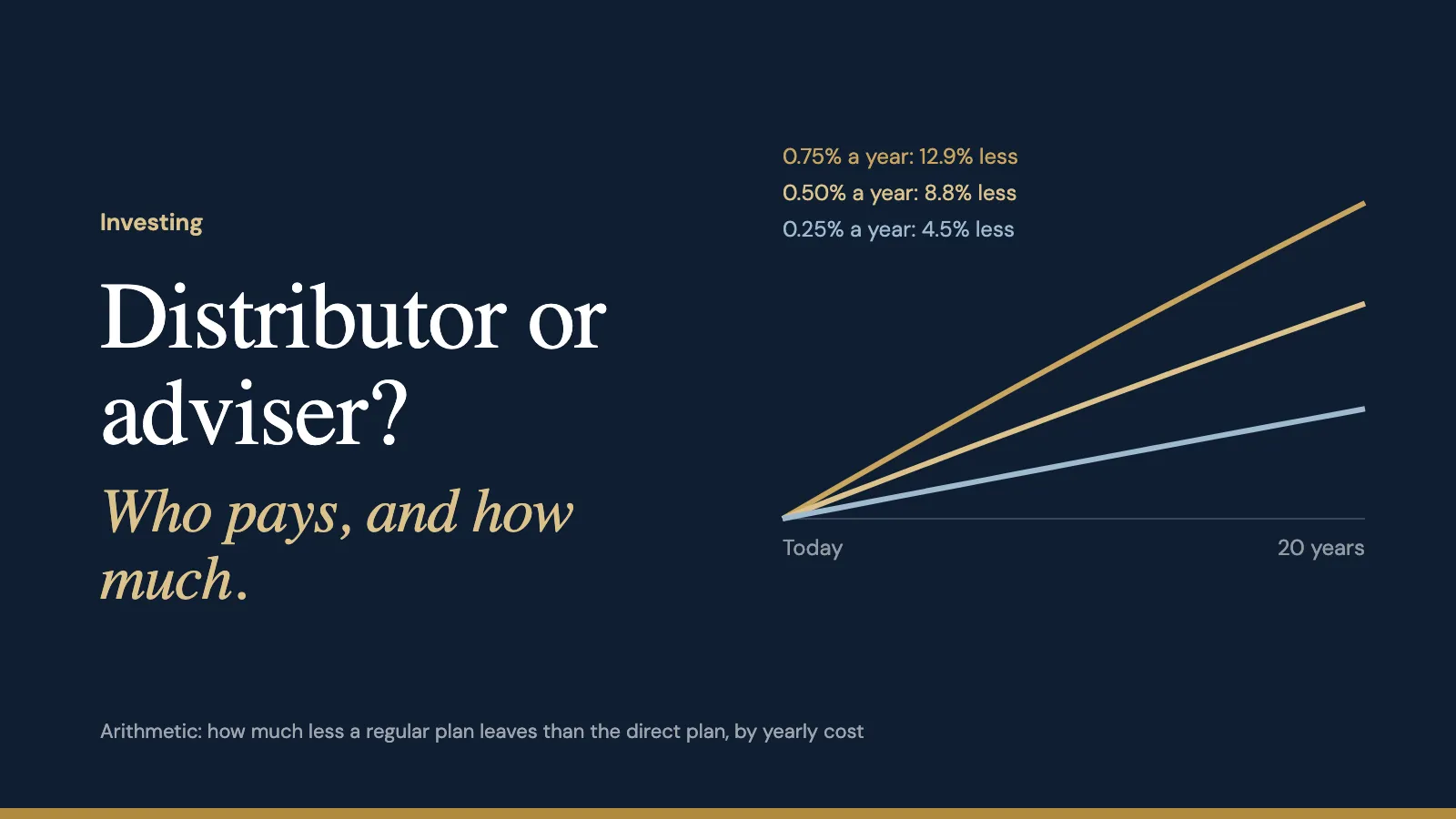
The commission is charged on a growing balance, so its cost grows with your money. Here’s how much less a regular plan would leave you than the direct plan of the same fund, for each size of yearly gap.
| Yearly gap | After 10 years | After 15 years | After 20 years |
|---|---|---|---|
| 0.25% | About 2.2% less | About 3.4% less | About 4.5% less |
| 0.50% | About 4.5% less | About 6.7% less | About 8.8% less |
| 0.75% | About 6.7% less | About 9.8% less | About 12.9% less |
Arithmetic, not a forecast: how much a yearly cost shrinks the final value, for any growth rate between 6% and 12% a year (the answer barely changes across that range).
That’s the honest price of a distributor. The question is whether what you get for it is worth more to you than that.
When are a direct plan and an RIA the better choice?
- You want advice with no product attached. An adviser is paid only by you, so nothing it recommends pays it more than anything else.
- You don’t need help doing it. If you’re comfortable choosing funds, doing the paperwork, and, hardest of all, sitting tight when markets fall, a direct plan on a fund house’s own website or app costs you less.
- Your portfolio is large. Commission is a percentage, so it grows with your money. An adviser’s fee may be a fixed amount, and SEBI limits what advisers can charge individual clients. On a large portfolio, compare the two in rupees a year.
- You want advice beyond mutual funds, on shares or your whole balance sheet.
If that’s you, an adviser and direct plans are probably the better arrangement, and we’d rather you knew it.
When does a distributor suit you?
- You want the work done with you. KYC, nominations, bank mandates, a change of address, or a claim after a death in the family. A distributor handles the paperwork.
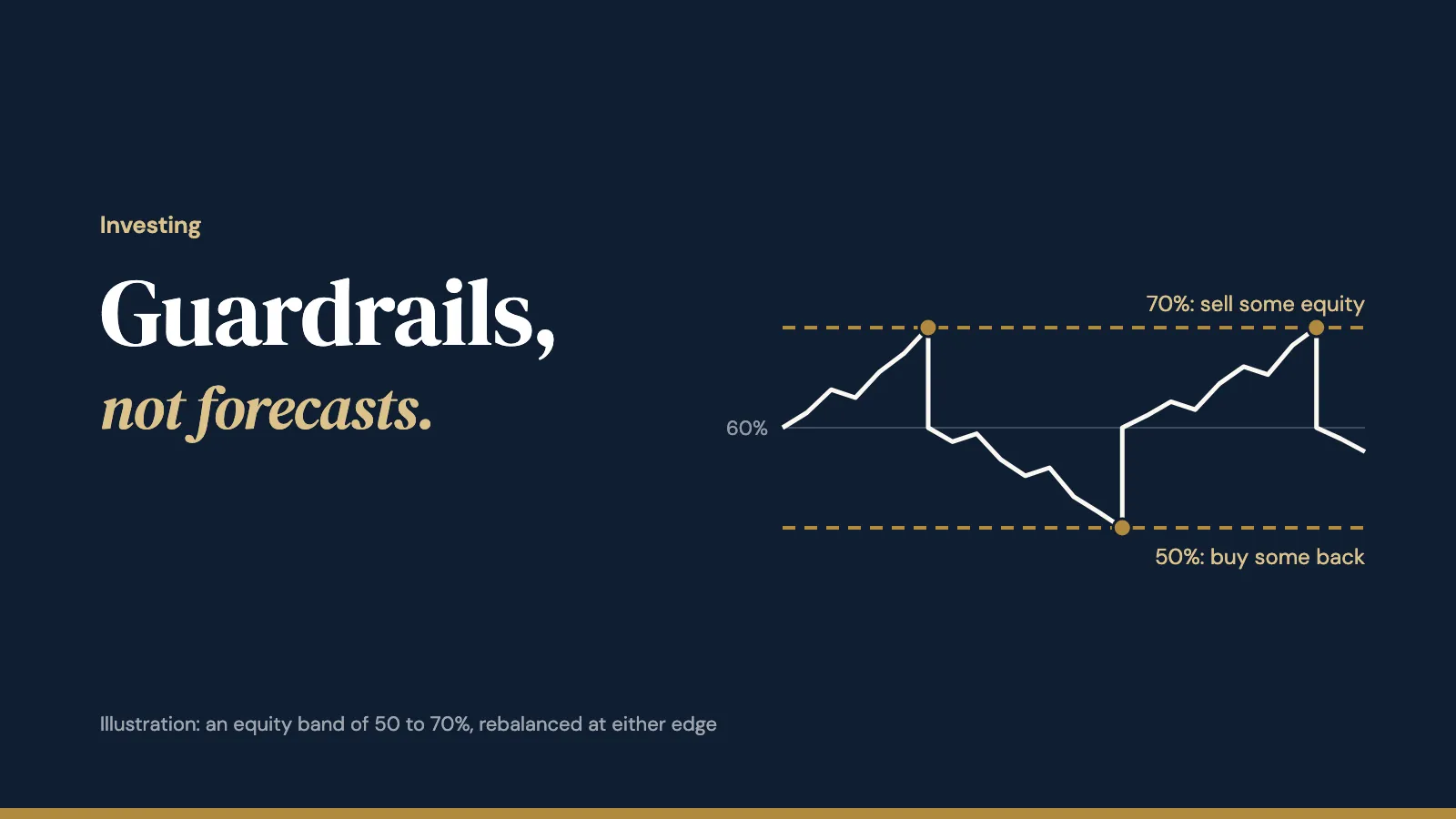
- You want someone beside you in bad years. Some of the costliest mistakes are about behaviour, not funds: stopping a SIP in a fall, or selling near the bottom. We write down, while things are calm, what you’ll do when they aren’t, and read it back to you when it counts. Read guardrails, not forecasts for how that works.
- You want a yearly review against your plan, without a separate fee for it.
- Your portfolio is still small. On ₹2 lakh, a 0.5% commission is ₹1,000 a year. A separate adviser’s fee could be more than that.
How do you check an ARN, an EUIN or an adviser?
A distributor. Search the name or ARN on AMFI’s Locate distributor page, which also links to lists of suspended and terminated ARNs. Ours is ARN-286779. Your account statement shows the ARN against each investment, and usually an EUIN (Employee Unique Identification Number), which identifies the person at the distributor who served you.
An adviser. On SEBI’s website, look under Registered Intermediaries, in the Investment Adviser category. Check the name, the registration number (it starts with INA) and that the registration is current.
Either way, your money should go to the mutual fund scheme itself, never into a person’s own account, and your units should be held in your own name.
Why do we say “mutual fund distributor”, not “adviser”?
Because that’s what we are, and the rules say the name should tell you.
Under SEBI’s Investment Advisers Regulations, no one distributing investments may call themselves an “independent financial adviser”, “IFA”, “wealth adviser” or any similar name unless they’re registered with SEBI as an investment adviser. In 2020, AMFI told distributors whose names used words like “adviser” or “wealth manager” to change them. Distributors must also show the words “AMFI-registered Mutual Fund Distributor” alongside their name and ARN.
The point is simple. From the name alone, you should know what someone is registered to do and how they’re paid. That’s why you’ll see “mutual fund distributor” across this site.
Looking for a financial advisor in Vijayawada?
If that’s what you searched for, you’ll find bank relationship managers, insurance agents, distributors and registered advisers, often using similar words. We’re a mutual fund distributor in Mangalagiri, between Vijayawada and Guntur. We’re not a SEBI-registered investment adviser.
Whoever you meet, us included, ask:
- What are you registered as, and what’s your number? Then check it yourself.
- How are you paid, in rupees, on what I’d invest? Ask for it in writing.
- What would a direct plan of the same fund cost me?
- Do you earn more on some products than on others?
- What will you do when markets fall?
- What won’t you do? We don’t run portfolios on your behalf (PMS), recommend individual shares, sell insurance, lend money, or file taxes.
- Where will my money be held? In your own name, with the fund house, is the answer you want.
What to do next
Read how we work, from the first conversation to the yearly review, and what our registration covers. If a distributor suits you, book a review call. If an adviser and direct plans suit you better, that’s a perfectly good answer too.