Goals
SIP for Child Education: What 15 Years Really Costs
Fees rise faster than almost anything else you pay for. Here is what a course could cost in 15 years, the monthly SIP that gets you there, when to move to steadier funds, and where Sukanya Samriddhi fits.
· 7 min read
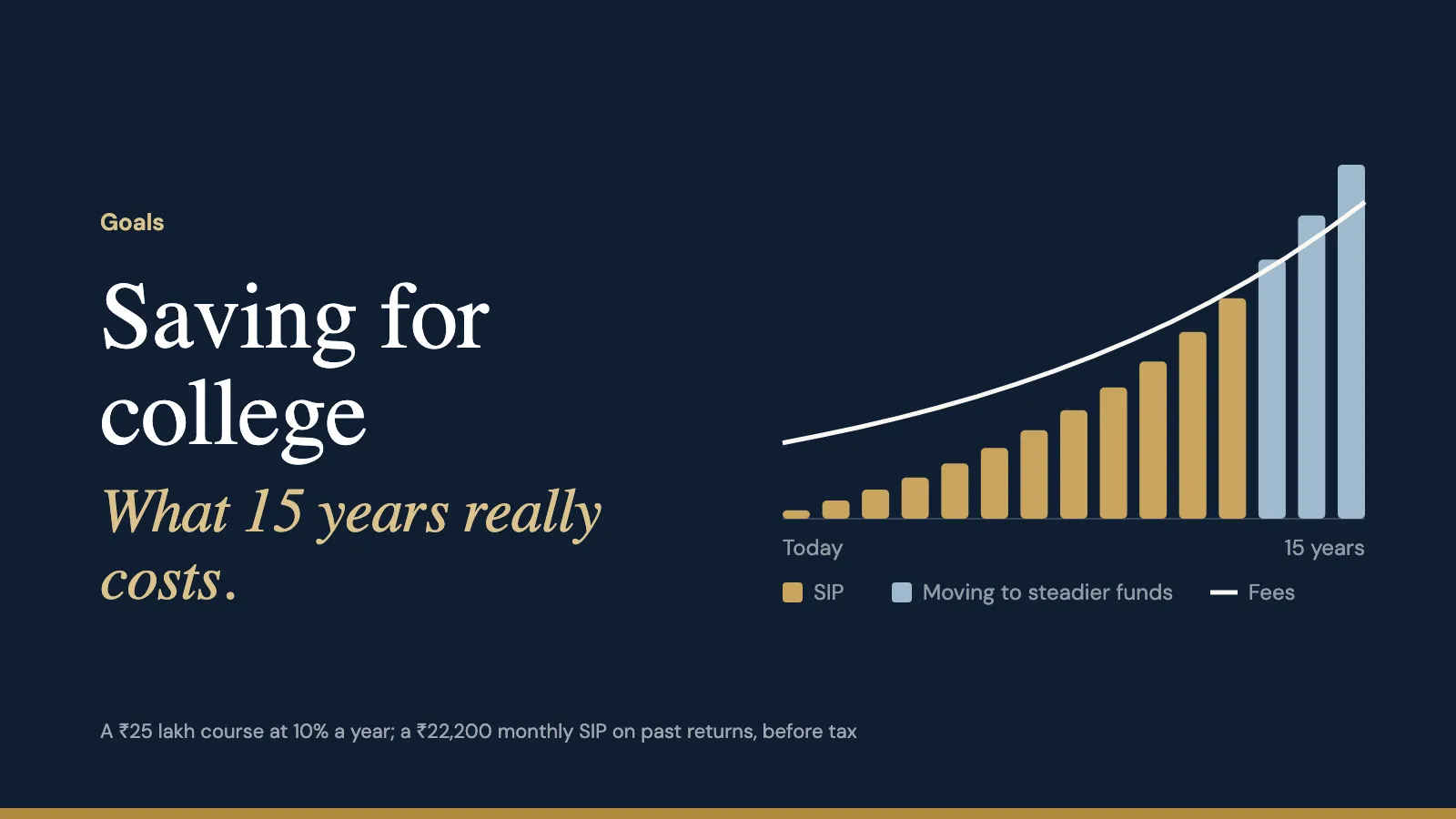
Your child is two, or five, or just born. College feels a long way off. But fees rise faster than almost anything else you pay for, and fifteen years is less time than it sounds.
Here’s what a course could cost by then, what to put away each month, and where Sukanya Samriddhi fits in.
The short answer
- A course costing ₹25 lakh today could cost about ₹1.04 crore in 15 years, if fees rise 10% a year. A ₹60 lakh professional course, about ₹2.51 crore.
- For the ₹25 lakh course, a SIP of about ₹22,200 a month gets you there, or one that starts at ₹12,900 and rises 10% a year, on our model portfolio’s average past returns.
- Start moving the money into steadier funds about three years before the fees are due, so one bad year near the end can’t derail it.
- For a daughter, Sukanya Samriddhi can sit alongside the SIP. Its rate is set by the government and it’s tax-free, but most of the money is locked in for years.
What will education cost in 15 years?
Nobody knows what a particular course will charge fifteen years from now. So we use two round numbers, as assumptions rather than quotes: a ₹25 lakh course and a ₹60 lakh professional course. Then we grow them at 10% a year, the rate our goal calculator assumes for education.
| Cost today (assumed) | In 15 years, at 8% a year | At 10% | At 12% |
|---|---|---|---|
| ₹25 lakh | ₹79.3 lakh | ₹1.04 crore | ₹1.37 crore |
| ₹60 lakh | ₹1.9 crore | ₹2.51 crore | ₹3.28 crore |
Fees growing at a steady yearly rate; the rates are assumptions, not forecasts.
At 10% a year, costs roughly quadruple in fifteen years. Better still, find out what the course your child might take costs today, with hostel and living costs, and use that number instead.
How much SIP for child education?
There are two ways to get there. A flat SIP puts in the same amount every month. A step-up SIP starts lower and rises every year, usually in line with your pay.
Here’s what each takes, starting from nothing, for 15 years.
| ₹25 lakh course | ₹60 lakh course | |
|---|---|---|
| Flat SIP | ₹22,200 a month | ₹53,300 a month |
| Rising 5% a year | ₹17,200, rising to ₹34,000 | ₹41,200, rising to ₹81,600 |
| Rising 10% a year | ₹12,900, rising to ₹49,000 | ₹31,000, rising to ₹1,17,700 |
| You put in: flat / 10% rise | ₹40 lakh / ₹49.2 lakh | ₹96 lakh / ₹1.18 crore |
Fees rising 10% a year. The SIP grows at our model portfolio’s average past returns: four equity funds and two debt funds held 50:50, about 13% a year over ten years. What’s left after tax on selling everything in the final year covers the cost. Past performance may or may not be sustained in future.
A few things to notice.
A step-up is easier now, but you put in more overall. It suits a young family whose pay will rise. But you’d put in ₹49.2 lakh instead of ₹40 lakh, because the larger later instalments have less time to grow.
What you’ve already saved helps a lot. With ₹5 lakh already put aside, the flat SIP for the ₹25 lakh course falls from ₹22,200 to ₹16,100.
Waiting is expensive. Start the flat SIP three years later and it rises to ₹35,200 a month. For the ₹60 lakh course, ₹84,400.
Why move to steadier funds three years before?
By the time the fees are three years away, most of the money is already there. The flat ₹22,200 plan would hold about ₹72.8 lakh at that point, over 60% of what it ends with. A sharp fall then would hit the largest sum the plan has ever held, with little time to recover. And the college won’t wait.
So as the goal gets close, its money moves step by step into steadier funds. This is called a glide path.
- About three years out, start moving a share each year out of equity funds into debt funds that lend for short periods. Money market funds, for example, lend for up to a year, and liquid funds for up to 91 days.
- By the year the fees are due, that year’s fees should be somewhere that doesn’t fall.
- Later years’ fees stay invested a little longer, and move in turn.
Two honest caveats. Steadier funds usually earn less, and the figures above don’t include that, so aim a little higher than them. And each move is a sale, so gains are taxed. On equity funds held over a year, gains above ₹1.25 lakh a year are taxed at 12.5%. Spreading the moves over three years lets you use that yearly ₹1.25 lakh more than once. Tax rules change with budgets; check with your CA.
SIP vs Sukanya Samriddhi: which is better?
Sukanya Samriddhi (SSY) is a government savings scheme for daughters, opened at a post office or bank. It isn’t really a rival to a SIP. It does a different job.
| Sukanya Samriddhi | SIP in mutual funds | |
|---|---|---|
| Who it’s for | A girl under 10, opened by a parent or guardian; up to two girls per family, more for twins or triplets | Anyone, for any goal |
| What it earns | A rate set by the government every quarter (check the current rate) | Rises and falls with markets; nothing is guaranteed |
| Paying in | ₹250 to ₹1.5 lakh a financial year, for the first 15 years | Any amount; change, pause or stop it |
| Taking money out | Up to 50% of the balance for her education once she turns 18 or passes Class 10; the rest at maturity, 21 years after opening | Any business day; an exit load may apply early on |
| Tax | Deposits qualify for the ₹1.5 lakh deduction long known as section 80C (old regime only); interest and maturity are tax-free | Gains taxed when you sell |
Tax rules change with budgets; check with your CA.
For a SIP, the tax depends on the fund. Gains on equity funds are taxed at 20% if held 12 months or less, and at 12.5% above ₹1.25 lakh a year after that. Debt funds bought since April 2023 are taxed at your slab rate.
Use them together. SSY’s strength is certainty: a government-set rate and no tax. Its weakness for education is access: only half of the balance is available at 18, and the full amount waits until 21 years after you opened it. A SIP can grow faster over fifteen years and you can reach it whenever you need to, but it can fall, sometimes just when you need it.
So, for a daughter, SSY can be the steady base and the SIP the part that grows.
Can you open a SIP for a minor?
Yes. A mutual fund folio can be opened in your child’s name, with you as guardian. In outline:
- The child is the only holder. There are no joint holders. A parent, or a court-appointed guardian, runs the folio until the child turns 18. You’ll need proof of the child’s date of birth and of your relationship, and your own KYC.
- You can pay from the child’s bank account, from a parent’s or guardian’s own account, or from a joint account of the two.
- Money taken out goes only to the child’s bank account, which can be held jointly with you.
- At 18, the folio changes status from minor to major. Your child completes their own KYC and gives their own bank details and signature. SIPs in the folio are set to stop at 18, and nothing more can be done in it until the change is made.
Until 18, gains in a child’s name are generally added to a parent’s income for tax. Tax rules change with budgets; check with your CA.
What to do next
- Find out what the course costs today, then put it, and the year you’ll need it, into the goal calculator.
- See what different monthly amounts, flat or rising, grow to in the SIP calculator.
- Read how our Wealth Builder service works out each goal, tests it at a lower return, and moves it to steadier funds as it gets close.
If you’d like to go through your own numbers with us, book a review call.